


Patent policy rarely makes front-page news. But for the innovators, companies, and members of the public who depend on a functioning patent system, the decisions made by a small group of officials during this administration have been consequential. Some have significantly moved the system in new directions. Some have held the line under intense pressure. And some are approaching the end of their time in their current roles — with the question of whether they will leave a lasting mark still open. Both critics and supporters agree: the USPTO has undergone one of the most significant shifts in a pro-patent direction in its history. What makes it more remarkable — it began under an acting director and has continued apace since.
This is the Clause 8 Eight: Government Officials Edition. Countdown from eight to one.
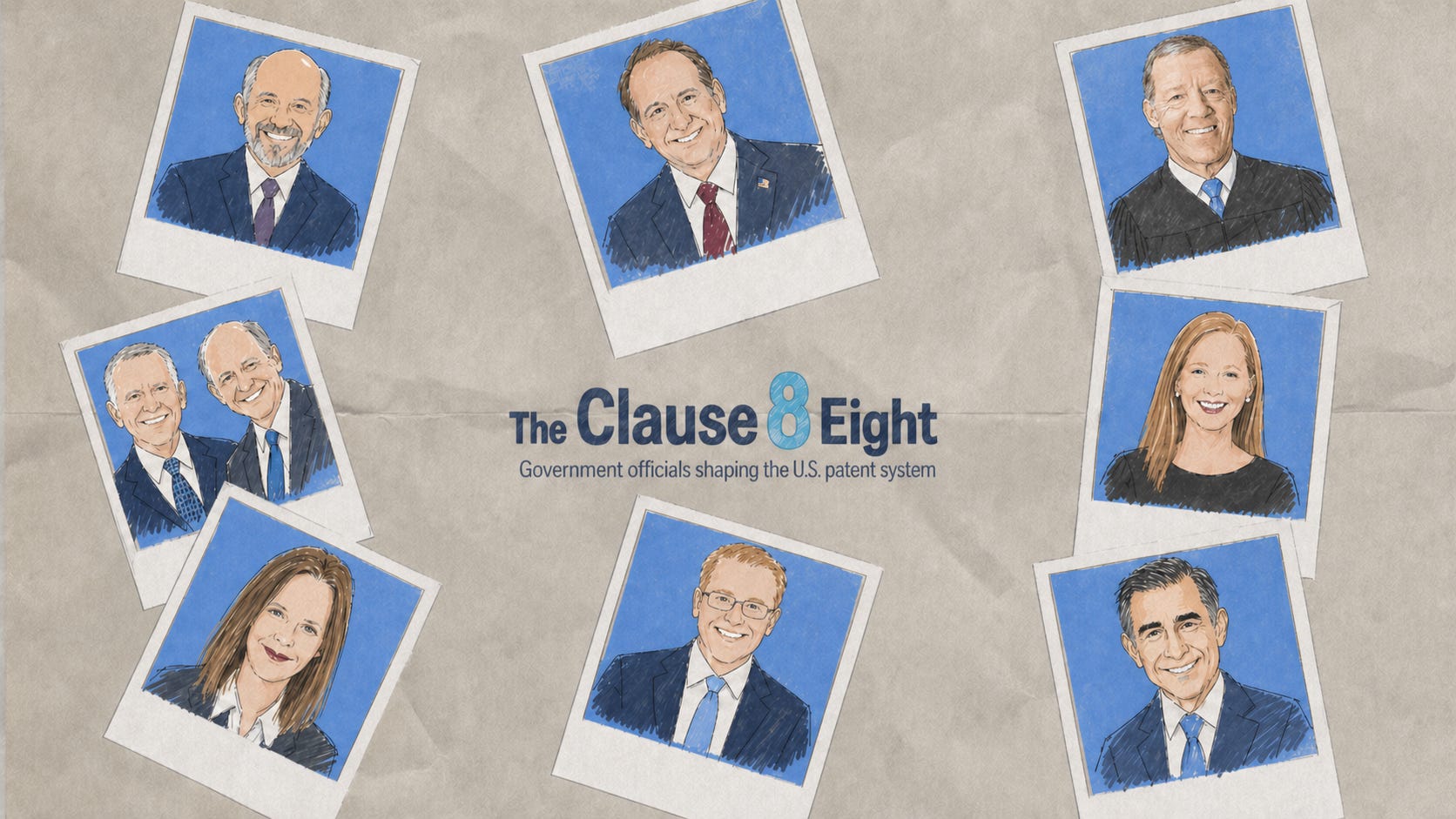
The Clause 8 Eight is a new Voice of IP feature. Disagree with the ranking? Think someone’s missing? Have ideas for future installments? Send them our way: eli@VoiceOfIP.com.
#8 Darrell Issa Chair, House Subcommittee on Courts, IP, AI, and the Internet
For years after the America Invents Act (AIA) passed, Congressman Issa carried the congressional baton on what he characterized as the continuing “patent troll” problem, pushing legislation in that direction that largely went nowhere. As the current USPTO has moved in a more pro-patent direction, his influence in shaping the agency’s trajectory has waned, and his recent hearing meant to raise alarm about the USPTO’s changes with regards to post-grant proceedings at the Patent Trial and Appeal Board (PTAB) largely fell flat. But as chair of the House’s IP Subcommittee, Issa remains a gatekeeper for any patent legislation hoping to move through the House. Whether he finds common ground with the Senate to make a lasting legislative impact before the end of his time in Congress remains the open question.
🎙️ Related: Issa’s Chief IP Counsel John Lee
#7 Dina Kallay Deputy Assistant Attorney General, DOJ Antitrust Division
Kallay has emerged as one of the most vocal voices within the current administration on the importance of patents in securing American technological leadership. Her speeches at the DOJ have staked out a position firmly on the side of innovators in the standard-essential patent (SEP) debate — including pointed remarks about the anti-competitive risks of so-called “royalty-free” licensing initiatives — and have been noticed by the innovation community. As Professor Kristen Osenga noted in a recent Clause 8 episode, Kallay’s pronouncements send a meaningful message in how the antitrust division is thinking about patent rights and standards.
🎙️ Related: The Hidden Costs of “Free” Patent Licensing Initiatives
#6 Judge Alan Albright U.S. District Court, Western District of Texas*
Judge Albright has spent his time on the bench as a one-man powerhouse proving that patent cases can be handled as expeditiously outside the EDTX as inside it. What makes his story notable is what he did — and didn’t do — when the pressure came. After an intense campaign targeting his Waco docket, the then WDTX Chief Judge implemented rules in 2022 to randomly reassign new patent cases filed there. Albright moved to Austin — and kept right on handling patent cases with the same approach. While others bent to the pressure, he continued doing what he believed was right. Whatever one thinks about where patent cases should be litigated, Albright stands as a notable example of judicial independence and a reminder of what a federal judge should look like when the pressure is on.
He has also created a playbook for other federal judges who believe that patent cases, like any other cases, should be resolved in a reasonable time. And even for judges who don't adopt his approach, Albright has set a standard they're now aware of — a benchmark for what efficient, predictable resolution can look like.
*Note: This list was finalized before Dani Kass of Law360 broke the news that Judge Albright will step down from the bench at the end of this summer. His impact on patent litigation — and on the standard set for resolving patent cases efficiently — will remain.
🎙️ Related: On Becoming the Go-To Judge for Patent Cases
#5 Nicholas Matich Solicitor, USPTO
You usually wouldn’t expect the USPTO Solicitor to make this list. But Nick Matich isn’t the usual USPTO Solicitor. He served at the USPTO during the last administration and joined the USPTO shortly after Coke Morgan Stewart as acting general counsel before being named Solicitor. Stewart herself has repeatedly credited Matich for his contributions in steering US patent policy in a new direction. The record: in partnership with Stewart, he has compiled a perfect record defending the USPTO’s PTAB-related actions at the Federal Circuit. Beyond the courtroom, Matich has been the architect of the PTAB rules package designed to ensure the changes being put in place now survive beyond this administration. It’s a priority he has pursued from the earliest days of the administration — drawing on lessons from his own previous time at the USPTO, when he watched much of what Director Andrei Iancu accomplished on the PTAB get unwound after the administration changed. As co-chair of the USPTO’s new SEP Working Group, Matich is also helping elevate standards policy as a matter of national importance.
🎙️ Related: Nick Matich on Rulemaking
#4 Senators Thom Tillis & Chris Coons U.S. Senate IP Subcommittee (tied)
No two people have done more to shape the congressional conversation around patent policy in recent years than Senators Tillis and Coons. The three major patent bills currently before Congress — PERA on Section 101, PREVAIL on PTAB reform, and the RESTORE Act on injunctions — are largely products of their efforts. That represents a significant shift from the post-AIA era, when the dominant congressional conversation was about cracking down on so-called “patent trolls.” Even with Tillis having announced his retirement and Coons succeeded on the subcommittee by Senator Adam Schiff, the legislative agenda they built continues to define what discussions around patent reform are focused on Capitol Hill and in the broader patent community.
🎙️ Related: Senator Tillis’ Patent Leadership · Senator Coons’ Staffer Phil Warrick
#3 John Squires Director, USPTO
Opponents of the USPTO’s early action on PTAB post-grant proceedings had hoped that Squires’ confirmation would mean a change in direction. Instead, he quickly proved he was going to proceed with full steam ahead along the path laid out by Coke Morgan Stewart and Nick Matich. His most notable early move: taking full personal responsibility for whether to institute IPR and PGR proceedings rather than delegating that decision — a shift that has meaningfully reduced the number of those proceeding. From his first day in office, he has also made Section 101 reform a priority, issuing guidance designed to bring more predictability to patent eligibility — though the USPTO is still in the early stages of implementation.
How lasting any of this proves to be will depend significantly on what happens legislatively, and on Squires’ ability to get the administration behind the legislative action needed to cement his vision for the patent system. His ultimate legacy will also rest in large part on whether he can improve patent examiner morale — reversing a dynamic that produced a record backlog under the last administration. The playbook already exists: David Kappos tackled a similarly daunting backlog by empowering examiners and encouraging collaboration with applicants, a model that reduced pendency and pushed USPTO morale to number one among federal agencies.
🎙️ Related: USPTO Director Squires’ Foxhole Buddy Tells All · Before He Became Director
#2 Coke Morgan Stewart Deputy Director, USPTO
No acting USPTO director has accomplished more in the role than Coke Morgan Stewart. Named Acting Director on the first day of the Trump administration, she used the role to drive significant change at a pace previously unseen from an acting director — who, historically, have minded the store until a permanent director is confirmed. She moved swiftly to recalibrate post-grant proceedings through her “settled expectations” approach, addressing head-on the perception that patents were subject to endless validity challenges. She also steered the agency through the turbulent early months of the new administration — keeping operations intact, refocusing the office on its core mission of examining patents, and doing all of it while inheriting a significant backlog from her predecessor. The first §101 memo of this administration was also issued under her watch as acting director. The foundation that Squires is building on is largely one she laid, and she continues to support it in her role as Deputy Director.
🎙️ Related: Right Choice for USPTO? · USPTO Changes & Patent Trends · Six Months In · Coke Morgan Stewart & Howard Lutnick
#1 Howard Lutnick Secretary of Commerce
Given that Howard Lutnick has credited patents for allowing him to rebuild Cantor Fitzgerald after 9/11 and is a named inventor on over 400 patents himself, Clause 8 expected him to play an outsized role in shaping America’s patent system as Commerce Secretary. So far, he has exceeded those expectations.
His biggest contribution has been giving USPTO’s political appointees the freedom to operate the agency as a genuinely pro-patent institution, arguably the most pro-patent posture the USPTO has taken since at least Bruce Lehman led it in the 1990s. His familiarity with patents has at times raised alarm in the pro-patent community, including by floating ideas regarding a patent value tax, exercising march-in rights, and taking a cut of universities’ “patent profits.” However, he has proved responsive to that feedback and dialed it back — at a Senate hearing, he declared “we will avoid harming innovation by not doing a valuation, or any valuation fee or tax on patents.”
His legacy with regards to shaping the patent system will rest on whether he can help shepherd the proposed PTAB rules package through the administration — and get the administration behind the legislative changes needed to make the current direction permanent.
🎙️ Related: Patents Saving Cantor Fitzgerald After 9/11 · Ex-USPTO Deputy Laura Peter on Proposals to Seize IP