


“The patent system changed this; secured to the inventor, for a limited time, the exclusive use of his invention; and thereby added the fuel of interest to the fire of genius…”
— Abraham Lincoln, 1859
As America approached its 250th birthday, I started thinking that Voice of IP should mark the occasion. Most of what I discuss on Clause 8 is the machinery of the patent world — the USPTO, the Hill, the courts, corporate IP strategy, new models for monetization, etc. But that machinery exists for one reason that’s often easy to lose sight of: innovation. So I decided that Voice of IP would put together a list of 250 American innovations, one for each year of the country, each tied to a US patent. I figured it would be a quick, easy project.
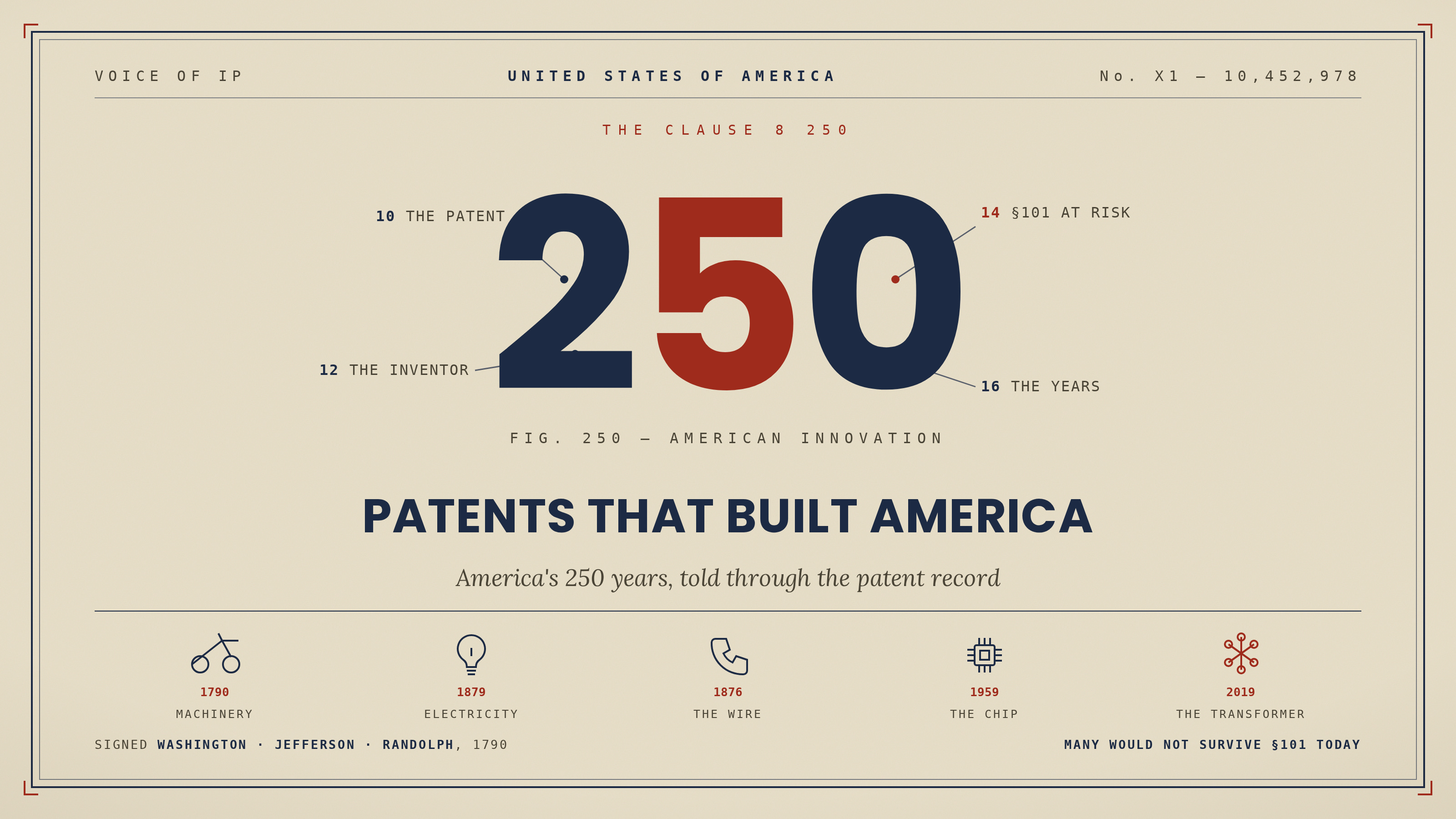
It was far more complicated than I expected. But working through those complications forced me to confront the messiness of innovation, patents, business, history—and lists like this one. Many of the discoveries and disputes I encountered appear in the “Notes” column of the table below. These were the broader themes that stayed with me:
Looking back, the current state of patent eligibility seems wildly ahistorical. This is the one that made me repeatedly sit back and think about how we have ended up in a very different place from when many of the innovations on the list were patented. Google’s PageRank patent, Netflix’s DVD-by-mail patent, Elon Musk’s business directory patent for his first company Zip2, and Jack Dorsey’s patent on tweeting have mostly expired but, at the time the applications were filed, they covered technologies and business models that became foundational to some of the biggest business empires in America. If filed today, they would likely all have trouble surviving the §101 gauntlet — facing rejection at the USPTO and, if issued, possible invalidation in the courts.
The same shift appears at the other end of the technological spectrum. Cohen and Boyer’s recombinant-DNA patent helped launch the modern biotechnology industry — Stanford and UCSF licensed it to roughly 470 companies — and it issued in 1980, three decades before the Supreme Court in Myriad held that isolated genes are unpatentable products of nature. PCR became a foundational technique underlying countless modern genetic tests. But diagnostic methods built around such testing now run headlong into Mayo v. Prometheus, which in 2012 recast correlating a biomarker to optimize treatment of autoimmune diseases, like Crohn’s, as an unpatentable “law of nature.” Whether the specific claims on these foundational patents would have survived today is unclear. The country patented its way to biotech under rules it has since walked back, which is why Senators Tillis and Coons have spent years trying to restore broader statutory eligibility.
That's largely true of patents for earlier innovations on the list too. The Monopoly patent anchored Parker Brothers' fortune; today, a patent on game rules would be dead on arrival. The Piggly Wiggly patent — Clarence Saunders's "self-serving store," the ancestor of every supermarket — would almost certainly be routed to a business-method art unit and buried under §101 rejections in today’s USPTO regardless of what the claims actually recite. Two iconic American commercial innovations might never have benefited from the fuel of interest the patent system was meant to provide.
Deciding who invented something is genuinely hard. History is murky, and the person a story remembers is often not the person on the patent. The foundational Solo Cup patent names an inventor almost nobody has heard of — Clarence Brewer — not the Solo Cup company scion — Robert Hulseman — celebrated in every obituary as the inventor of the “red Solo Cup.” George Mitchell is called the father of fracking, but the man who invented and patented hydraulic fracturing decades earlier was a Stanolind engineer named Riley Floyd Farris. Sometimes the famous name belongs to the businessman rather than the engineer who quietly invented and moved on to solving the next technical problem. Because this list is tied to patents, we went with the inventors named on the patents and tried to note where the patent record and the folklore diverge.
Every list like this reflects choices — including this one. Who gets into a hall of fame, who gets remembered as “the” inventor, which technologies count: those are choices, and there’s no perfect way to make them. I want to be upfront about that. There are millions of US patents and we chose 250. So, I’ve resisted calling these the “greatest” American inventions. It’s a snapshot of the innovation that happened here, told through the patent system that recorded it. And taken together, the stories are also a reminder of what can happen when people have the freedom—and the incentive—to pursue an idea. One pattern was impossible to miss: a remarkable number of the named inventors on this list were immigrants.
Commercial success makes patents targets. Once an invention becomes popular, someone often tries to design around, narrow, invalidate, or otherwise take down the patent protecting it. That’s another clear theme running through the whole list. Alexander Graham Bell’s telephone patents survived roughly 600 lawsuits. Robert Kearns fought Detroit for a decade over the intermittent wiper and won. Others were challenged and weren’t as lucky in the courts. But losing in court does not erase the underlying invention. Those inventors remained on the list even as the legal disputes sometimes made the judgment calls harder.
What struck me most is how little this has changed overall: the independent inventor who has to fight to enforce a patent isn't a modern problem. It's the oldest story in the system — Bell was living it in the 1870s, and many inventors are living it today.
American invention has two prominent faces, and both are on this list. One is the lone inventor — the widow, the machinist, the professor, the founder — with nothing behind them but a patent. The other is the corporate research lab: the same names surface again and again—Bell Labs, IBM, DuPont, 3M, GE—institutions that made invention systematic and gave their researchers the resources to develop, commercialize, and defend their work. The list reflects both traditions, along with many other American companies that built enduring businesses around patented innovation.
A note on method. This is a list of innovations tied to US patents — a deliberate choice. Some great American inventions found other routes to success. And we made no pretense of ranking impact — there's no made-up formula here scoring inventions against each other. Instead, we tried to tell two stories at once: the story of significant American innovation, and the story of how Americans have relied on the patent system to protect it, which is why the list includes inventors like Abraham Lincoln and Howard Lutnick and some personal favorites that have simply made us smile (the wine chiller is staying).
We also folded in the milestone “millionth” patents—1,000,000 through 11,000,000—as snapshots of what America was patenting each time the odometer rolled over. No. 12,000,000 exists, of course. But every list needs an ending, and the age of AI suggested a more fitting one. It took 121 years to reach the first million, in 1911; the most recent million took only about three. The recent milestones are worth a second look because the USPTO now hand-selects which patent receives the round number, making each one a statement by the Office about what counts as “important” innovation.
The list opens with US Patent X1 — a method for making potash, personally signed in 1790 by George Washington, Thomas Jefferson, and Edmund Randolph — and runs to the transformer architecture that now underpins frontier AI models.
250 years, 250 inventions.
All 250 are in the table below. If you’re reading in email or in Substack app, open the full post in browser for the table. Prefer plain text? See the list in full after the table.
The Clause 8 250: The Full List
The Founding Era (1790–1860)
1790 — Potash making process. Samuel Hopkins. US Patent X1. America’s first patent. It was personally signed by George Washington, Thomas Jefferson, and Edmund Randolph. Potash was used in fertilizer, soap, and glass and became America’s first industrial export.
1790 — Automated flour mill. Oliver Evans. 3rd US patent (destroyed in the 1836 fire). The world’s first fully automated production line that moved grain through every milling step with almost no human hands, a century before Ford. George Washington licensed it for his Mount Vernon mill. The original patent was one of the patents lost in the 1836 Patent Office fire, and it became among the most litigated of the era (four separate Supreme Court cases).
1793 — Cotton gin. Eli Whitney. US Patent X72. Remade the Southern economy — for better and worse
1809 — Straw-weaving process. Mary Dixon Kies. US Patent 1041X. The first US patent issued to a woman — a technique for weaving straw with silk for hats. The “X” marks it as a pre-1836 patent reconstructed after the Patent Office fire; the original was among those lost.
1821 — Dry scouring (dry cleaning). Thomas Jennings. US Patent 3306X. The first US patent issued to an African American; a prominent abolitionist, he poured his earnings into the anti-slavery movement.
1834 — Mechanical reaper. Cyrus McCormick. US Patent X8277. The horse-drawn reaper that mechanized the grain harvest — one man could now cut in a day what a dozen did with scythes. McCormick’s aggressive licensing and litigation built one of America’s first industrial giants, later folded into International Harvester.
1836 — Locomotive traction wheels. John Ruggles. US Patent 1. Patent No. 1 of the modern series: when the 1836 fire destroyed the old unnumbered records, the Patent Office restarted its count, and Senator John Ruggles — who wrote the reform law that did it — took No. 1, for a cogged wheel to keep locomotives from slipping on steep grades.
1836 — Revolver. Samuel Colt. 138 (later X9430X; reissued as No. 124, 1848).
1838 — Telegraph. Samuel Morse. US Patent 1,647.
1843 — Multiple-effect evaporator (sugar refining). Norbert Rillieux. US Patent 3,237. The basis of all modern industrial evaporation — sugar, condensed milk, soap, glue. Rillieux was a Louisiana Creole and a pioneer of chemical engineering.
1843 — Ice cream freezer. Nancy Johnson. US Patent 3,254. The hand-cranked ice-cream freezer — a paddle churning custard inside a chilled cylinder, essentially the design still sold today.
1844 — Vulcanized rubber. Charles Goodyear. US Patent 3,633. Discovered vulcanization by accident — rubber and sulfur on a hot stove. Spent most of his life on patent-related litigation; Goodyear won in US but lost priority battle to Thomas Hancock in England; Got a rare seven-year extension on US Patent due to inadequate compensation but still died $200,000 in debt.
1846 — Sewing machine. Elias Howe. US Patent 4,750. The first great patent war (”Sewing Machine War”)→ the first patent pool (1856).
1846 — Ether anesthesia (”Letheon”). William Morton. US Patent 4,848. Prospect of enforcement sparked fierce criticism from medical community.
1847 — Rotary printing press. Richard Hoe. US Patent 5,199. Type mounted on a spinning cylinder, printing thousands of sheets an hour, made the mass-circulation daily newspaper possible.
1849 — Safety pin. Walter Hunt. US Patent 6,281. Sold the rights for $400.
1849 — Buoying vessels over shoals. Abraham Lincoln. US Patent 6,469. Only president with a patent.
1851 — Improvements to sewing machine. Isaac Singer. US Patent 8,294. The Sewing Machine War’s other half
1852 — Beehive (movable frame). Lorenzo Langstroth. US Patent 9,300.
1856 — Condensed milk. Gail Borden. US Patent 15,553. Shelf-stable canned milk — Borden vacuum-boiled milk to keep it from spoiling on long journeys, after watching children die from tainted milk on an Atlantic crossing. Nourished Union armies through the Civil War.
1858 — Pencil with eraser. Hymen Lipman. US Patent 19,783. Struck down by the Supreme Court as obvious (Reckendorfer v. Faber, 1875).
1858 — Mason jar. John Landis Mason. US Patent 22,186. Allowed ordinary households to safely preserve food at home. Mason died in poverty.
1859 — Signal flares. Martha Coston. 23,536 / 115,935. A widow who spent a decade perfecting her late husband’s sketch; the Navy bought it. The 1859 patent (23,536) issued under his name with Martha as administratrix; her own improvement patent came in 1871 (115,935).
1860 — Repeating rifle. Benjamin Tyler Henry. US Patent 30,446. The first reliable lever-action repeater revolutionized firearms.
The Machine Age (1861–1900)
1861 — Elevator safety brake. Elisha Otis. US Patent 31,128. A spring-loaded catch that locked the elevator car if the cable snapped. Made elevators survivable and skyscrapers possible.
1861 — Pin-tumbler cylinder lock. Linus Yale Jr.. US Patent 31,278. Small, cheap, pick-resistant mechanism still inside most door keys today.
1862 — Gatling gun. Richard Gatling. US Patent 36,836. The first practical rapid-fire gun — hand-cranked rotating barrels.
1865 — Self-scouring steel plow. John Deere. US Patent 46,454.
1868 — Typewriter (QWERTY). Christopher Latham Sholes. US Patent 79,265. The first commercially successful typewriter; the QWERTY keyboard was arranged to stop the mechanical typebars from jamming.
1869 — Air brake. George Westinghouse. US Patent 88,929. The compressed-air brake that let one engineer stop an entire train at once — before it, brakemen ran car to car turning wheels by hand. It made long, fast, heavy railroads safe.
1869 — Waffle iron. Cornelius Swartwout. US Patent 94,043. A stovetop iron with a handle to flip it without burning your hand.
1870 — Celluloid. John Wesley Hyatt. US Patent 105,338. First commercial plastic
1871 — Cable car. Andrew Hallidie. US Patent 110,971. Grips a continuously moving underground cable to climb hills too steep for horses. Still running in San Francisco.
1871 — Flat-bottom paper bag machine. Margaret Knight. US Patent 116,842. The machine that folds and glues the flat-bottom paper bag, still the basic design today. A man who saw her prototype copied it and filed first; Knight won in an interference proceeding.
1871 — Adjustable garment strap (the “bra clasp”). Samuel Clemens (Mark Twain). US Patent 121,992. Twain created this elastic clasp for vests and pants; the clasp only later migrated to bras (the bra itself wasn’t patented until 1914). Twain later went bankrupt backing others’ inventions and soured on the patent system. Still, in his novel A Connecticut Yankee in King Arthur’s Court, he had the main character declare a country without a patent office “couldn’t travel any way but sideways or backways.”
1872 — Vaseline (petroleum jelly). Robert Chesebrough. US Patent 127,568. Chesebrough sold it door to door by burning his own skin with acid or flame, then healing the wound with his invention.
1872 — Automatic engine lubricator. Elijah McCoy. US Patent 129,843. Imitators were so inferior buyers demanded “the real McCoy.”
1873 — Riveted blue jeans. Jacob Davis & Levi Strauss. US Patent 139,121. Rivets on corners of pockets and base of fly led to jeans’ popularity. Davis was an immigrant tailor who couldn’t afford the filing fee, asked his supplier Strauss to pay to obtain the patent together, and the happily went to work overseeing (what became) Levi’s first manufacturing facility for jeans.
1874 — Barbed wire. Joseph Glidden. US Patent 157,124. Fenced the American West; massive litigation led to Supreme Court eventually upholding the patent in 1874.
1876 — Telephone. Alexander Graham Bell. US Patent 174,465. Bell successfully defended the patent in over 600 court cases.
1876 — Carpet sweeper. Melville Bissell. US Patent 182,346. Swept the floor before the vacuum existed.
1878 — Phonograph. Thomas Edison. US Patent 200,521. Edison called it his favorite invention.
1878 — Cash register. James & John Ritty. US Patent 221,360. Saloonkeeper tired of theft came up with cash register; patented improved version that a paper tape as the recording mechanism and pop-up numbers to indicate sales.
1879 — Incandescent bulb (carbon filament). Thomas Edison. US Patent 223,898. Edison perfected, patented, marketed, and litigated over the incandescent bulb. Lewis Latimer’s longer-lasting carbon filament, patented soon after, helped make it practical.
1879 — The Selden automobile patent. George Selden. US Patent 549,160. The patent attorney who claimed the automobile itself — and collected royalties from nearly every carmaker until Henry Ford refused to pay, fought for eight years, and won. The patent that taught America what designing around means.
1883 — Shoe-lasting machine. Jan Ernst Matzeliger. US Patent 274,207. Surinamese immigrant; cut shoe prices in half.
1884 — Fountain pen. Lewis Waterman. US Patent 293,545. The leak-free pen.
1885 — Folding cabinet bed. Sarah E. Goode. US Patent 322,177. A cabinet that folds into a writing desk, a space-saver for cramped city apartments and a direct ancestor of the Murphy bed. Goode, a Chicago store owner who was likely born enslaved, was among the first Black women to hold a US patent.
1885 — Dishwasher. Josephine Cochrane. US Patent 355,139. The first pressure-jet dishwasher. Cochrane was 45-year old widow in debt when she filed the patent as “J.G. Cochran,” supposedly to hide that she was a woman.
1887 — Automatic elevator doors. Alexander Miles. US Patent 371,207. Riders used to fall down open shafts.
1887 — Gramophone (disc record). Emile Berliner. US Patent 372,786. German immigrant; the format that beat Edison’s cylinder.
1887 — Railway induction telegraphy. Granville Woods. US Patent 373,915. A way for moving trains to send and receive telegraph messages through induction to the rails so dispatchers could locate trains and prevent collisions. Although known as the “Black Edison,” Woods beat Edison himself in both interference fights over this technology.
1888 — Paper drinking straw. Marvin Stone. US Patent 375,962. Replaced the rye-grass straws that made drinks taste like hay.
1888 — AC induction motor. Nikola Tesla. US Patent 381,968. Serbian immigrant.
1888 — Revolving door. Theophilus Van Kannel. US Patent 387,571.
1888 — Kodak roll-film camera. George Eastman. US Patent 388,850.
1889 — Punch-card tabulator. Herman Hollerith. US Patent 395,782. Built for the 1890 Census; laid the foundation for computer programming. Hollerith’s company became IBM.
1891 — Automatic telephone exchange. Almon Strowger. US Patent 447,918. An undertaker who invented dial switching because the town operator — his rival’s wife — was diverting his business calls.
1891 — Carbon black. Edwin Binney & C. Harold Smith. US Patent 453,140. Apparatus for the Manufacture of Carbon-Black” — the pigment behind printing ink, shoe polish, and the black in every car tire.
1892 — Crown bottle cap. William Painter. US Patent 468,258. Mentored King Gillette: “invent something used and thrown away.
1892 — Escalator. Jesse Reno. US Patent 470,918.
1892 — Improved ironing board. Sarah Boone. US Patent 473,653. Born enslaved in North Carolina; her curved, reversible board is the typical modern one.
1893 — Ferris wheel. William Somers. US Patent 489,238. Somers patented the wooden “Roundabout” — the ride George Ferris rode before building his “Ferris Wheel.” Sommers unsuccessfully sued Ferris for infringement.
1893 — Zipper (clasp locker). Whitcomb Judson. US Patent 504,038. It took another twenty years, and Gideon Sundback, to make it practically work.
1894 — Snap mousetrap. William Hooker. US Patent 528,671.
1898 — Radio-controlled boat. Nikola Tesla. US Patent 613,809. The first remote control
1898 — Flashlight. David Misell. US Patent 617,592. Made portable electric light possible. David Misell’s name is on the patent, but the Russian-Jewish immigrant Conrad Hubert (born Akiba Horowitz) is often wrongly identified as the inventor. Hubert was the owner of the Eveready company that Misell worked at.
Electricity, Flight & War (1901–1945)
1903 — Windshield wiper. Mary Anderson. US Patent 743,801. A manufacturer rejected it as having “no commercial value”; the 17-year patent term expired just as wipers became standard equipment. Anderson never made a cent.
1903 — Airplane. Wright Brothers. US Patent 821,393. The patent war → WWI cross-license (proto-patent-pool #2).
1904 — Safety razor with disposable blades. King Gillette. US Patent 775,134.
1906 — Air conditioning. Willis Carrier. US Patent 808,897.
1907 — Track-type tractor (”Caterpillar”). Benjamin Holt. US Patent 874,008. Holt-vs-Best patent wars ended in the 1925 merger that created Caterpillar.
1908 — Triode vacuum tube (Audion). Lee de Forest. US Patent 879,532. Electronic amplifiter that revoluationaized telecommunications and broadcasting.
1908 — Portable electric vacuum. James Spangler. US Patent 889,823. An asthmatic janitor; sold to his cousin’s husband — a man named Hoover.
1909 — Bakelite. Leo Baekeland. US Patent 942,699. First fully synthetic plastic; Belgian immigrant.
1911 — ◆ Patent No. 1,000,000 (vehicle tire). Francis Holton. US Patent 1,000,000. A tubeless, puncture-resistant rubber tire — and it took the country 121 years, from 1790, to reach its first million patents.
1914 — Liquid-propellant rocket. Robert Goddard. US Patent 1,102,653. Multi-stage rocket fueled with a solid “explosive material.” Goddard dies in 1945 but his estate filed suit against US goverment for patent infringement, leading to record $1M settlement after 9 year litigation.
1914 — Toy electric train. Joshua Lionel Cowen. US Patent 1,113,312.
1914 — Safety hood / gas mask. Garrett Morgan. US Patent 1,113,675. Early version of modern gas mask
1914 — Modern bra. Mary Phelps Jacob. US Patent 1,115,674. The first US bra patent.
1915 — Electric self-starter. Charles Kettering. US Patent 1,150,523. Used to start an internal combustion engine. Killed the manual hand crank.
1917 — Zipper (modern). Gideon Sundback. US Patent 1,219,881. The zipper that actually worked — Sundback’s interlocking teeth replaced Judson’s failure-prone hooks and eyes.
1917 — Self-service grocery store. Clarence Saunders. US Patent 1,242,872. A patent on the supermarket itself.
1918 — Gyrocompass. Elmer Sperry. US Patent 1,279,471. Spinning gyroscope that finds true north without magnetism, unaffected by a steel ship’s hull. It made modern naval navigation and autopilot possible.
1920 — Modern parachute. Floyd Smith. US Patent 1,340,423. Freefall parachute with a manual ripcord — letting a jumper fall clear of a disabled aircraft before opening the canopy, rather than having it tethered to the plane. Design made bailing out survivable.
1920 — Superheterodyne radio. Edwin Armstrong. US Patent 1,342,885. His FM patent war with RCA ended in his suicide.
1921 — Pop-up toaster. Charles Strite. US Patent 1,394,450. A timer and spring that eject the toast and cut the heat before it burns.
1923 — 3-position traffic signal. Garrett Morgan. US Patent 1,475,024. Added the ‘caution’ interval between stop and go.
1924 — Popsicle. Frank Epperson. US Patent 1,505,592. Invented at age 11.
1924 — Vitamin D irradiation. Harry Steenbock. US Patent 1,680,818. Led to the birth of university tech transfer. Steenbock found that irradiating food with ultraviolet light filled it with vitamin D — a cure for the rickets then crippling children. Offered $1 million for it by Quaker Oats, he instead put up $300 of his own to found the Wisconsin Alumni Research Foundation (WARF) in 1925, the first university patent-licensing office. WARF successfully licensed the patent until the Ninth Circuit Court of Appeals, noting the patent kept vitamin-D foods from the poor, invalidated it in 1945.
1925 — Peanut-derived products. George Washington Carver. US Patent 1,522,176. Not peanut butter, as is often mistaken
1926 — Band-Aid. Earle Dickson. US Patent 1,612,267.
1927 — Hard hat. Edward Bullard. US Patent 1,699,133.
1927 — Electronic television. Philo Farnsworth. US Patent 1,773,980. RCA paid $1 million settlement after initially trying to buy it from Farnsworth for $100,000 in 1931 and decade of litigation
1928 — Permanent wave machine. Marjorie Joyner. US Patent 1,693,515. Machine to set long-lasting waves in hair.
1930 — Flash-frozen food. Clarence Birdseye. US Patent 1,773,079.
1930 — M1 Garand rifle. John C. Garand. US Patent 1,892,141. The rifle that armed every GI in WWII — Patton: “the greatest battle implement ever devised.” He never made a dime; the bill to award him $100K failed in Congress.
1930 — Norden bombsight. Carl Norden & Theodore Barth. US Patent 2,428,678. Gyroscopic precision bombsight configured to drop a bomb in a pickle barrel from 30,000 feet.
1931 — Freon. Thomas Midgley. US Patent 1,833,847. Refrigeration made safe.
1931 — Tampon with applicator. Earle Haas. US Patent 1,926,900.
1931 — Climbing rose. Henry Bosenberg. US Patent PP1. Plant Patent No. 1 following the passage of the 1930 Plant Patent Act.
1932 — Bread-slicing machine. Otto Rohwedder. US Patent 1,867,377.
1932 — Modern uplift bra / cup sizing (Maidenform). William Rosenthal. US Patent 1,979,576. Ida Rosenthal is often credited as the creator of the modern bra but her husband William was named on the key patents. Ida did eventually get a patent of her own, a 1942 adjustable fastener.
1935 — Helicopter (practical). Igor Sikorsky. US Patent 1,994,488. Born in Kyiv; fled the Russian Revolution and landed in New York with $600.
1935 — ◆ Patent No. 2,000,000 (vehicle wheel). Joseph Ledwinka. US Patent 2,000,000. A wheel to make pneumatic tires safer and longer-lasting — the second million took just 24 years, against 121 for the first.
1935 — Monopoly. Charles Darrow. US Patent 2,026,082.
1935 — Kodachrome color film. Leopold Mannes & Leopold Godowsky. US Patent 2,113,329. The first commercially successful modern color film.
1935 — Scotch transparent tape. Richard Drew. US Patent 2,177,627. Drew invented masking tape first, in 1925, for auto painters doing two-tone jobs; the same adhesive-coating know-how led him to this cellophane version. Legend says a frustrated painter told a 3M rep to take his stingy tape back to his “Scotch” bosses, and the name stuck.
1937 — Electric guitar (”Frying Pan”). George Beauchamp. US Patent 2,089,171. Later perfected by Les Paul’s solid body
1938 — Nylon. Wallace Carothers. US Patent 2,130,948. The first fully synthetic fiber, spun from coal, air, and water.
1938 — Fiberglass. Games Slayter, with Thomas & Kleist. US Patent 2,133,236. Mass-producible glass-fiber insulation → Owens Corning.
1939 — Shopping cart. Sylvan Goldman. US Patent 2,155,896.
1940 — Slow cooker (Crock-Pot). Irving Naxon. US Patent 2,187,888. Inspired by his grandmother’s cholent
1941 — Teflon. Roy Plunkett. US Patent 2,230,654. Near-frictionless nonstick coating.
1942 — Frequency-hopping spread spectrum. Hedy Kiesler Markey & George Antheil. US Patent 2,292,387. A radio-guidance system for torpedoes that rapidly hops between frequencies so the signal can’t be jammed — the ancestor of the spread-spectrum techniques in Wi-Fi, Bluetooth, and GPS. Markey was the movie star known as “Hedy Lamarr” under her married name; Antheil was a composer. They donated the patent to the war effort but the technology went unused for decades.
1942 — Xerography. Chester Carlson. US Patent 2,297,691.
1942 — Mobile refrigeration. Frederick McKinley Jones. US Patent 2,303,857. Refrigerated trucking, cold chain, wartime blood transport.
1943 — Aerosol spray can. Lyle Goodhue & William Sullivan. US Patent 2,331,117. Pressurized aerosol spray can was first built by the USDA so GIs could blast malaria mosquitoes in the Pacific. It’s now used for hairspray, spray paint, and everything else sprayed out of a can.
1944 — Nuclear reactor. Enrico Fermi & Leó Szilárd. US Patent 2,708,656.
The Postwar Boom & the Chip (1946–1980)
1946 — Pulse-code modulation (digital communication). Bernard Oliver & Claude Shannon. US Patent 2,801,281. How analog reality becomes digital signal — the foundation under digital telephony, the CD, and everything streamed. Filed the same years Shannon coined the “bit.”
1947 — Slinky. Richard James. US Patent 2,415,012.
1947 — <br />General-purpose electronic digital computer (ENIAC)<br />. J. Presper Eckert & John Mauchly. US Patent 3,120,606. Invalidated in Honeywell v. Sperry Rand, 1973.
1948 — Penicillin mass production. Andrew Moyer. 2,442,141 / 2,443,989.
1948 — Streptomycin (first TB antibiotic). Albert Schatz & Selman Waksman. US Patent 2,449,866. Schatz, the grad student, did the bench work isolating it; Waksman took the Nobel and tried to write him out; Schatz sued and won legal recognition as co-discoverer. A third team member, Elizabeth Bugie, got erased almost entirely.
1948 — Transistor. John Bardeen & Walter Brattain. US Patent 2,524,035. The 2,524,035 patent names Bardeen & Brattain; Shockley’s rival junction transistor (2,569,347) is separate — he was furious to be left off, then built the better device.
1949 — Tupperware seal. Earl Tupper. US Patent 2,487,400. Airtight plastic food containers with the ‘burping’ seal — a flop in stores until Brownie Wise invented the home Tupperware party to sell them.
1949 — Hydraulic fracturing (”fracking”). Floyd Farris. US Patent 2,596,843. George Mitchell is popularly called “the father of fracking,” but the actual inventor was Stanolind engineer Floyd Farris, who ran the first “Hydrafrac” experiment in 1947 (gelled gasoline and sand) and patented it.
1950 — Microwave oven. Percy Spencer. US Patent 2,495,429.
1950 — Cruise control. Ralph Teetor. US Patent 2,519,859. Teetor was blind since age five and annoyed by his lawyer’s uneven driving.
1951 — Instant photography. Edwin Land. US Patent 2,543,181. Polaroid v. Kodak, $909M verdict
1951 — Disposable diaper. Marion Donovan. US Patent 2,556,800.
1952 — Barcode. Norman Woodland & Bernard Silver. US Patent 2,612,994.
1952 — LP record (33⅓ microgroove). Peter Goldmark. US Patent 2,950,116. The album as an art form — up to \~23 minutes a side, vinyl instead of shellac, a microgroove a third the old width. Immigrant from Budapest.
1953 — Ice resurfacer. Frank Zamboni. US Patent 2,642,679.
1953 — Airbag. John Hetrick. US Patent 2,649,311. A crash sensor triggering an inflating cushion.
1954 — 6-mercaptopurine / rational drug design. Gertrude Elion & George Hitchings. US Patent 2,697,709. First effective drug against childhood leukemia — and the birth of designing drugs from biochemistry instead of trial-and-error.
1954 — Wiffle ball. William F. Blamey Jr. & David N. Mullany. US Patent 2,776,139.
1954 — Hard disk drive (RAMAC). Louis Stevens, William Goddard & John Lynott. US Patent 3,134,097.
1956 — Wireless TV remote (Space Command). Robert Adler. US Patent 2,817,025. First practical wireless remote — ultrasonic, battery-free, struck aluminum rods like a tiny xylophone.
1957 — Silicon solar cell. Daryl Chapin, Calvin Fuller & Gerald Pearson. US Patent 2,780,765. Turned sunlight into usable electricity, led to solar panels and satellites.
1957 — Super Glue. Harry Coover. US Patent 2,794,788.
1958 — Containerized shipping. Malcom McLean. US Patent 2,853,968. The box that made globalization.
1959 — Precision wire resistor. Otis Boykin. US Patent 2,891,227. Electronic components used in everything from pacemaker control units to guided missiles.
1959 — Barbie. Jack Ryan. US Patent 3,009,284. Public credits Mattel co-founder Ruth Handler, but the utility patent names designer Jack Ryan.
1959 — Integrated circuit. Jack Kilby. US Patent 3,138,743.
1960 — Laser. Arthur Schawlow & Charles Townes. US Patent 2,929,922.
1960 — Bubble wrap. Marc Chavannes. US Patent 3,142,599.
1960 — Computerized Reservation System. Evelyn Berezin. US Patent 3,253,262. First computerized airline-reservation system.
1961 — Planar IC. Robert Noyce. US Patent 2,981,877. The ‘planar’ version of the integrated circuit (IC) that could be mass produced.
1961 — ◆ Patent No. 3,000,000 (automatic reading system). Kenneth Eldredge. US Patent 3,000,000. An early optical character reader that turned printed characters into machine code — a real computing landmark hiding behind a round number.
1962 — Implantable pacemaker. Wilson Greatbatch. US Patent 3,057,356.
1963 — Hula Hoop. Arthur Melin & Richard Knerr. US Patent 3,079,728.
1963 — Tubular steel roller coaster. Karl Bacon & Ed Morgan. US Patent 3,114,332. Basis for every modern steel roller coaster.
1963 — Perceptron (first neural network). Frank Rosenblatt. US Patent 3,287,649. The first machine that could learn — the Navy announced it in 1958 and the NYT called it “the embryo of an electronic computer that will walk, talk, see, write.” Neural nets came back to power everything on the modern AI stack.
1964 — Electret microphone. James West & Gerhard Sessler. US Patent 3,118,022. Used in 90% of the world’s microphones.
1964 — Clean room. Willis Whitfield. US Patent 3,158,457. Every chip and every drug on this list gets made inside this invention.
1964 — Intermittent windshield wiper. Robert Kearns. US Patent 3,351,836.
1965 — Play-Doh. Noah & Joseph McVicker. US Patent 3,167,440.
1966 — Visible LED. Nick Holonyak. US Patent 3,249,473. First visible light-emitting diode (LED); LEDs now light nearly everything.
1966 — Home security system (CCTV). Marie Van Brittan Brown & Albert Brown. US Patent 3,482,037. Ancestor of every video doorbell and smart-home camera.
1967 — AstroTurf. James Faria & Robert Wright. US Patent 3,332,828.
1968 — Valium. Leo Sternbach. US Patent 3,371,085. Polish immigrant.
1968 — DRAM. Robert Dennard. US Patent 3,387,286. Dynamic random-access memory (DRAM) is the primary working memory in most computer systems.
1968 — Microprocessor. Gilbert Hyatt. US Patent 4,942,516. Single integrated-circuit chip for a computer that is at the heart of all modern consumer electronic products.
1969 — Balloon embolectomy catheter. Thomas Fogarty. US Patent 3,435,826. Surgical device used to rapidly remove blood clots.
1969 — Moog synthesizer. Robert Moog. US Patent 3,475,623.
1969 — Residential smoke detector. Lyman Blackwell. US Patent 3,735,375.
1969 — Charge-coupled device (CCD). Willard Boyle & George Smith. US Patent 3,858,232. Core image snsor in digital cameras, etelescopes, sensors, etc.
1970 — Computer mouse. Douglas Engelbart. US Patent 3,541,541. Patent expired before the mouse mattered; SRI licensed to Apple for a pittance.
1971 — Scotchgard stain repellent. Patsy Sherman & Samuel Smith. US Patent 3,574,791.
1971 — String trimmer (Weed Eater). Melvin Geist & George Ballas. US Patent 3,708,967.
1971 — Networked ATM. Don Wetzel et al.. US Patent 3,761,682.
1972 — Wheeled luggage. Bernard Sadow. US Patent 3,653,474.
1972 — Kevlar. Stephanie Kwolek. US Patent 3,671,542. Aramid fiber five times stronger than steel by weight, commonly used for bulletproof vests.
1972 — Modern athletic shoe (waffle sole). Bill Bowerman. US Patent 3,793,750.
1973 — Low-loss optical fiber. Robert Maurer, Donald Keck & Peter Schultz. US Patent 3,711,262. The first optical fiber pure enough to carry light for miles with little loss — made fiber-optic communication, and the modern internet’s backbone, possible.
1973 — Home video game console. Ralph Baer. US Patent 3,728,480. German refugee; beat Atari in court.
1974 — GPS. Roger Easton. US Patent 3,789,409.
1974 — MRI. Raymond Damadian. US Patent 3,789,832.
1974 — Taser. Jack Cover. US Patent 3,803,463.
1974 — Solo cup (”Thin Walled Cup”). Clarence T. Brewer. US Patent 3,951,266. Every obituary credits Robert Leo Hulsema but the patent names Clarence T. Brewer as the inventor of the technology that made the solo cup possible.
1975 — Wearable insulin pump. Dean Kamen. US Patent 3,858,581. The first wearable infusion pump so patients could dose medication continuously instead of by injection.
1975 — Laser printer. Gary Starkweather. US Patent 3,867,571.
1975 — Handheld cell phone. Martin Cooper. US Patent 3,906,166. First call: his rival at Bell Labs
1976 — Implantable defibrillator. Michel Mirowski, Morton Mower, Alois Langer & Stephen Heilman. US Patent 3,942,536. The implantable defibrillator — a device that lives in the chest, watches for a fatal arrhythmia, and shocks the heart back into rhythm. Colleagues called it impossible; Mirowski, who had watched a friend die of sudden cardiac death, built it anyway.
1976 — Gore-Tex. Bob Gore. US Patent 3,953,566. The waterproof-but-breathable membrane used for rain gear.
1976 — ◆ Patent No. 4,000,000 (asphalt recycling). Robert Mendenhall. US Patent 4,000,000. A process for recycling old road surfaces into new asphalt — issued the year of the Bicentennial.
1976 — Video game cartridge. Ronald A. Smith & Nicholas Talesfore. US Patent 4,095,791.
1977 — EpiPen. Sheldon Kaplan. US Patent 4,031,893. A spring-loaded device that drives a precise dose in seconds for emergency treatment of life-threatening allergic reactions.
1977 — Ethernet. Robert Metcalfe. US Patent 4,063,220. The standard that lets many computers share one wire without their signals colliding into noise. It still connects most of the wired world.
1978 — Digital camera. Steven Sasson. US Patent 4,131,919.
1979 — Personal computer (Apple II). Steve Wozniak. US Patent 4,136,359. The personal computer-with-video-display patent.
1979 — Artificial heart (Jarvik-7). Robert Jarvik. US Patent 4,173,796. The first permanent artificial heart — Barney Clark lived 112 days on it in 1982. Basis for continuing work in field.
1979 — Sports bra. Lisa Lindahl, Hinda Miller & Polly Smith. US Patent 4,174,717.
1980 — Statins (lovastatin). Richard Monaghan, Alfred Alberts & Carl Hoffman. US Patent 4,231,938. A cholesterol-blocking compound isolated from a fungus, and the start of the best-selling class of drugs in history.
1980 — Recombinant DNA. Stanley Cohen & Herbert Boyer. US Patent 4,237,224. Method for splicing genes into bacteria so they manufacture proteins on demand. Foundational patent for genetic-engineering.
The Digital Turn (1981–2000)
1981 — Oil-eating bacterium. Ananda Chakrabarty. US Patent 4,259,444. Specialized microorganisms that use enzymes to break down petroleum hydrocarbons into carbon dioxide and water. Diamond v. Chakrabarty (Supreme Court held invention was patent eligible under §101 in 5–4 decision.
1981 — Li-ion cathode (lithium cobalt oxide). John Goodenough & Koichi Mizushima. US Patent 4,302,518. The cathode chemistry behind every lithium-ion battery.
1982 — Prozac. Bryan Molloy & Klaus Schmiegel. US Patent 4,314,081. The first SSRI antidepressant. By adjusting serotonin rather than blunting the whole nervous system, it reshaped how the world treats depression.
1982 — Machine vision / automated identification. Jerome Lemelson. US Patent 4,338,626.
1983 — Controlled drug delivery. Robert Langer. US Patent 4,391,797.
1983 — Public-key cryptography (RSA). Ron Rivest, Adi Shamir & Leonard Adleman. US Patent 4,405,829. Public-key cryptography allows strangers to exchange secrets over an open line, and the reason online banking and e-commerce can work today. The three MIT inventors’ initials name it: RSA.
1983 — Super Soaker. Lonnie Johnson. US Patent 4,591,071.
1984 — Thermal inkjet. John Vaught & HP team. US Patent 4,490,728. The mechanism in every HP inkjet printer.
1986 — 3D printing. Chuck Hull. US Patent 4,575,330.
1986 — Nicotine patch. Frank Etscorn. US Patent 4,597,961.
1987 — PCR. Kary Mullis. US Patent 4,683,202. The polymerase chain reaction (PCR) is a way to copy a single strand of DNA into billions, the technique behind DNA fingerprinting, genetic testing, and modern biology.
1988 — Palmaz coronary stent. Julio Palmaz. US Patent 4,733,665.
1988 — OncoMouse. Philip Leder & Timothy Stewart. US Patent 4,736,866. Genetically modified laboratory mouse engineered to facilitate cancer research.
1988 — Laserphaco cataract surgery. Patricia Bath. US Patent 4,744,360.
1988 — Spinal fusion devices. Gary Michelson. US Patent 5,015,247. First threaded spinal-fusion implant. Patent portfolio sold to Medtronic for $1.35 billion — likely the biggest individual-inventor sale in history.
1989 — LASIK. Gholam Peyman. US Patent 4,840,175. Iranian immigrant
1989 — Interactive voice response (”press 1 for...”). Ronald A. Katz. US Patent 4,845,739.
1990 — CDMA cellular technology. Klein Gilhousen, Irwin Jacobs, Lindsay Weaver & Charles Wheatley. US Patent 4,901,307. The foundation for modern cellular communication standards.
1991 — ◆ Patent No. 5,000,000 (ethanol from microbes). Lonnie Ingram, Tyrrell Conway & Flavio Alterthum. US Patent 5,000,000. A method using E. coli to make fuel ethanol, from the University of Florida.
1993 — “Hub and spoke” financial method. R. Todd Boes. US Patent 5,193,056. A data-processing system for pooling mutual funds in a “hub and spoke” structure to cut costs and win tax advantages. In State Street Bank v. Signature Financial (1998) the Federal Circuit famously upheld it and swept away the old “business method exception.
1993 — Post-it Notes. Art Fry. US Patent 5,194,299.
1995 — CMOS active pixel sensor (camera-on-a-chip). Eric Fossum. US Patent 5,471,515. The sensor in every phone camera.
1996 — Lyrica (pregabalin). Richard Silverman. US Patent 5,563,175. Compound that became the blockbuster nerve-pain and seizure drug Lyrica.
1996 — Online maps & directions. Elon Musk & Maurice Fitzgerald. US Patent 5,944,769. Interactive business directory service with integrated maps and directions.”
1998 — Google PageRank. Larry Page. US Patent 6,285,999.
1999 — Amazon 1-Click. Peri Hartman, Jeff Bezos, Shel Kaphan & Joel Spiegel. US Patent 5,960,411.
1999 — ◆ Patent No. 6,000,000 (file syncing). Jeffrey Hawkins & Michael Albanese. US Patent 6,000,000. A snapshot of 1999: one-button syncing of files between a PC and a handheld, invented at Palm, maker of the PalmPilot.
2000 — Content delivery network (CDN). Tom Leighton & Daniel Lewin. US Patent 6,108,703. Accelerates internet content delivery by caching assets—like HTML, images, and videos—closer to users Lewin was killed aboard AA Flight 11 on 9/11 — likely the attack’s first victim.
2000 — Virtual yellow first-down line. Stan Honey. US Patent 6,141,060. “Method and apparatus for adding a graphic indication of a first down to a live video of a football game”
The Connected Century (2001–2019)
2001 — Spanx. Sara Blakely. US Patent 6,276,176. The footless, seamless shaping garment. The patent made Blakely the youngest self-made woman billionaire.
2003 — Electronic Treasury trading. Howard Lutnick et al.. US Patent 6,560,580. Lutnick is among the most prolific US inventors ever (400+ patents) and is now the Commerce Secretary overseeing the USPTO. The ‘580 was held unenforceable in eSpeed v. BrokerTec (Fed. Cir. 2007) but his innovations regarding electronic Treasury trading still remade the market.
2003 — DVD-by-mail method. Reed Hastings, Marc Randolph & Neil Hunt. US Patent 6,584,450. Netflix’s foundational patent, enforced it against Blockbuster in 2006.
2005 — Roomba. Joseph L. Jones, Newton E. Mack, David M. Nugent & Paul E. Sandin. US Patent 6,883,201.
2005 — Bionic Wrench. Dan Brown. US Patent 6,889,579.
2006 — ◆ Patent No. 7,000,000 (biodegradable fiber). John O’Brien. US Patent 7,000,000. A biodegradable polysaccharide fiber for low-cost textiles, from DuPont.
2006 — mRNA modification. Katalin Karikó & Drew Weissman. US Patent 8,278,036.
2007 — Ridesharing (shared-transport matching). Sean O’Sullivan. US Patent 7,840,427.
2007 — Tweeting. Jack Dorsey & Biz Stone. US Patent 8,401,009.
2009 — VoIP. Marian Croak. US Patent 7,599,359. Voice over Internet Protocol — not Voice of IP.
2009 — Slide to unlock. Imran Chaudhri, Bas Ording & others. US Patent 8,046,721. The patent on sliding your thumb to unlock a phone — one of the arsenal of iPhone-interface patents (alongside multi-touch, US 7,479,949, “the Steve Jobs patent”) Apple wielded in the smartphone wars.
2011 — ◆ Patent No. 8,000,000 (visual prosthesis). Robert Greenberg, Kelly McClure & Arup Roy. US Patent 8,000,000. An implant that delivers neural stimulation to create artificial vision for the blind (Second Sight).
2012 — Kiva warehouse robots. Mick Mountz, Raffaello D’Andrea & Peter Wurman. US Patent 8,280,547. The robots inside every Amazon fulfillment center.
2013 — Square card reader. Jim McKelvey (Square, with Dorsey). US Patent 8,534,546.
2013 — reCAPTCHA. Luis von Ahn. US Patent 8,555,353.
2013 — Flippy tablet stand. Bruce Cannon & Juliette Fassett. RE48,479.
2014 — CRISPR gene editing. Feng Zhang. US Patent 8,697,359.
2014 — Ephemeral messaging (Snapchat). Evan Spiegel & Robert Murphy. US Patent 9,537,811.
2015 — ◆ Patent No. 9,000,000 (windshield washer). Matthew Carroll. US Patent 9,000,000. A system that collects rainwater to refill your windshield-washer reservoir.
2015 — Bunch O Balloons. Josh Malone. US Patent 9,051,066. Product to fill up and self-tie 100+ water balloons in 60 seconds. Clause 8 guest, Ep. 16.
2017 — Structure-based vaccine design. Barney Graham & Jason McLellan. 9,738,689 / 10,960,070. The stabilized spike inside COVID vaccines.
2017 — Vinglace wine chiller. Colton Haas. US Patent 9,988,202. Editor’s indulgence. A vacuum-insulated, glass-lined bottle holder that keeps wine cold without ice — proof the patent system still turns up for a well-made everyday object.
2018 — ◆ Patent No. 10,000,000 (coherent LiDAR). Joseph Marron. US Patent 10,000,000. Laser detection and ranging (LiDAR), from Raytheon — and the USPTO now curates these milestones: a GE scientist openly timed two filings hoping to land this number.
2019 — ◆ Patent No. 11,000,000 (heart-valve stent). Saravana Kumar & Jason Diedering. US Patent 11,000,000. A collapsible stent frame for a heart valve, built by a Minnesota startup that began in a garage. Filed 2019, granted 2021 — the last million took about three years.
2019 — Transformer architecture. Ashish Vaswani et al.. US Patent 10,452,978.