


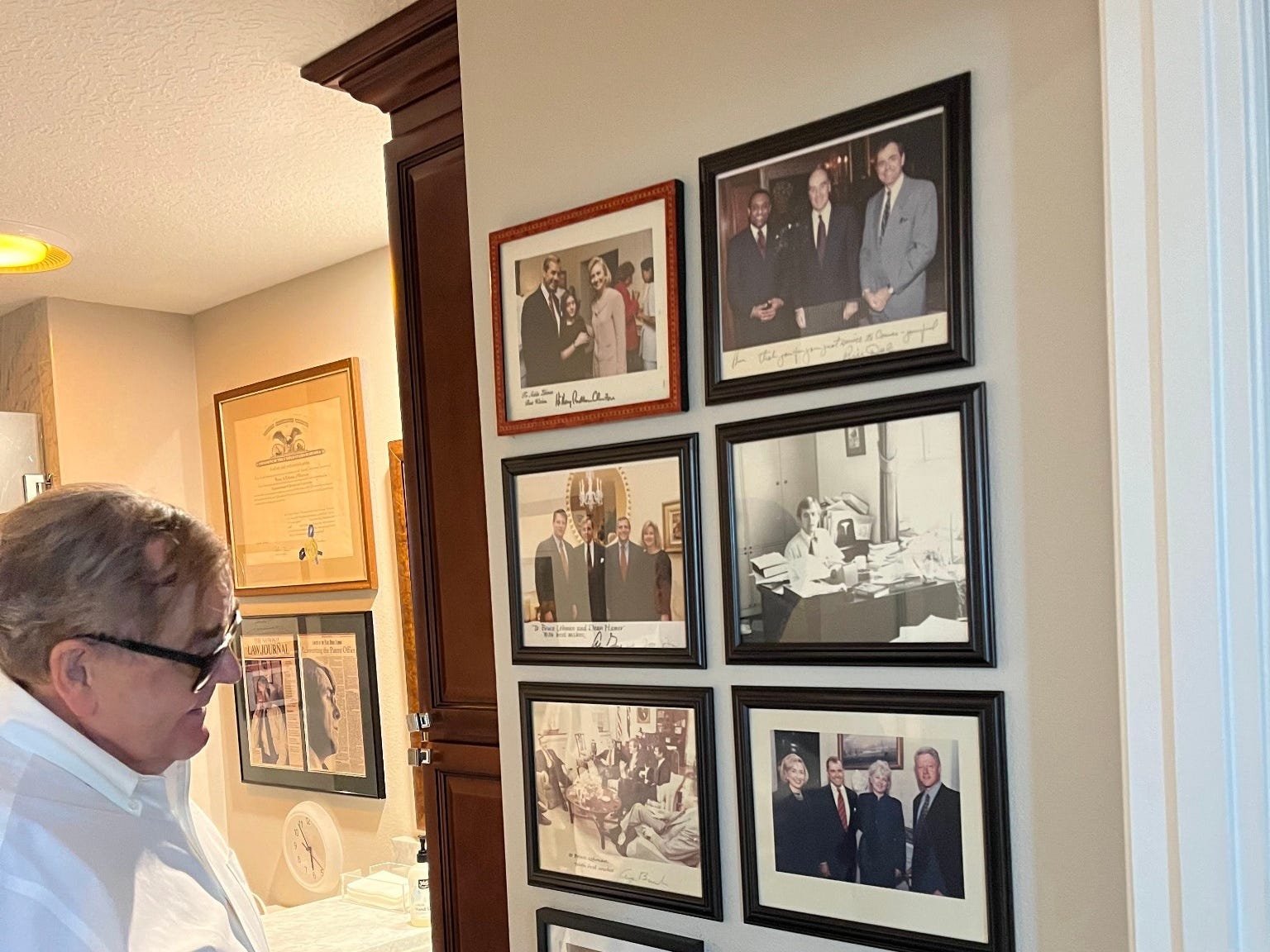
When Bruce Lehman announced that he would step down as head of the USPTO in 1998, Teresa Riordan devoted her regular “Patents” column in The New York Times to Lehman’s time at the USPTO and observed that “defenders and detractors tend to agree on one point: That Mr. Lehman has raised the visibility of intellectual property by transforming what was formerly a bench-warming position into a prominent perch.” The Times has not covered another USPTO head’s departure in the same way since.1 And the Times stopped running the “Patents” column altogether in the early 2000s.2
It turned out that Lehman’s prominent tenure was more of an exception likely because of who he was rather than any lasting transformation of the role - and coincided with a high point of America’s modern appreciation for IP. Lehman, now happily retired in Florida, sat down with Eli Mazour at his home to record this special Clause 8 episode. Lehman shares his candid perspective on the role he played in the major IP developments of the modern era, his time as head of the USPTO during the dot-com boom, and what has followed, including the lessons he draws from dealing with the rise of the internet for today’s AI moment.
On the USPTO’s gallery of past leaders, Lehman’s is the first portrait in color — a small marker of where he sits in the agency’s history.
“I am a card-carrying member of the Deep State.”
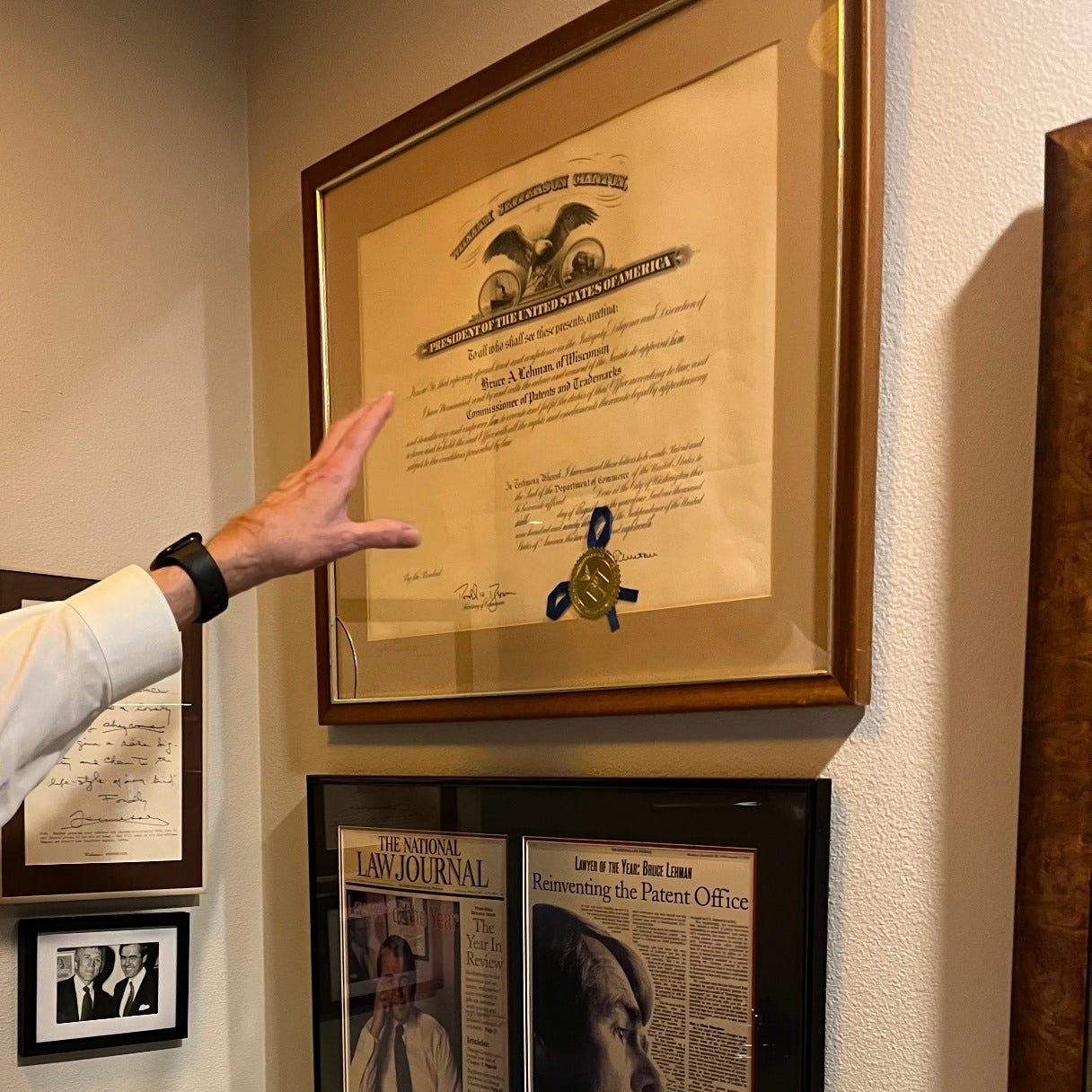
Lehman was not a member of the patent bar — or, as he affectionately joked after the recording, a member of “the priesthood” — but was a man of Washington and deeply cared about IP issues when he was nominated by President Bill Clinton in 1993 to helm the USPTO. By that point, he had spent close to two decades focused on IP issues on Capitol Hill, starting as counsel to his home-state Wisconsin Rep. Bob Kastenmeier on the House Judiciary Committee, where he worked on major copyright legislation (including the 1976 Copyright Act), patent policy (including the Bayh-Dole Act), and supporting the broader government architecture that helped connect IP to American competitiveness.
During the episode, Lehman proudly says he was “a card-carrying member of the Deep State” and “a member of the club.” That mattered.
To the surprise of many, but not Lehman himself, he was unanimously confirmed by the Senate as the first openly gay man ever confirmed by that body — something he describes as “probably the most historic thing I’ve ever done.” He tells the story of Sen. Strom Thurmond wanting to personally explain why he was supporting him, and walking into the room behind the Senate Judiciary Committee chamber where he knew almost everyone there.
Those deep Washington relationships also explain why he was able to have a uniquely expansive impact on IP policy once he was confirmed as head of the USPTO, including on copyright even though that falls outside the official purview of the USPTO.
From inside the USPTO during the internet boom, he helped steer the WIPO Copyright Treaties — the foundation for what became the DMCA — and the TRIPS-era push that put IP at the center of Clinton's economic agenda.
New Copyright Legislation in the Age of AI?
Lehman delivered the legislative response to the internet boom. Asked whether the AI boom requires another, he doesn't hesitate.
That history makes Lehman’s critique of today’s environment more striking: the country that once pushed the world toward stronger IP protection is now often debating how far to weaken it.
Lehman sees this through what he calls the “patent pendulum” — the idea that US IP policy historically moves through cycles of strong and weak protection. In his telling, strong IP rights help create new industries. Those industries become dominant. Then the companies with market power often lose interest in strong IP rights because they no longer need them.
That, he argues, is where we are now. Lehman argues that courts have spent the last two decades weakening copyright through an expansive view of fair use. The result, in his view, is that AI companies are now using massive amounts of human-created content to train models without giving creators a meaningful stake.
He calls that “fundamentally immoral.”
So when asked whether new legislation is needed to protect creators in the AI age, Lehman did not hedge.
“The short answer is yes.”
Whether Congress in 2026 can pull off what it did in the 1990s is its own question. But the DMCA’s architect has a unique vantage point to argue that it should try.
The episode covers:
The DMCA before it was the DMCA — how the Clinton administration’s internet copyright work became the foundation for the 1996 WIPO Copyright Treaties and later US legislation.
TRIPS, WIPO, and the globalization of IP — how the US helped strengthen IP rights around the world in the 1990s, and why that history contrasts so sharply with today’s debates over patents, fair use, AI, and access to technology.
Why Lehman thinks AI requires new copyright legislation — and why he believes courts have taken fair use too far.
Limits of AI — why Lehman believes AI can process vast databases but lacks the “metaphysical” spark behind true invention.
The “patent pendulum” — Lehman’s framework for understanding US IP policy as a cycle between strong-protection and weak-protection eras.
Bayh-Dole and the rise of the university-to-startup pipeline — including why Lehman sees the statute as central to the development of modern Silicon Valley.
Historic confirmation as the first openly gay man confirmed by the US Senate.
How he turned the USPTO into a “prominent perch” for national IP policy, even though copyright formally sits outside the agency.
Gilbert Hyatt, submarine patents, and SAWS — including Lehman’s view that Hyatt was “abused and mistreated.”
USPTO’s telework & modernization for internet age — how the agency became an early large-scale telework test case and why Lehman thinks it transformed examiner retention and efficiency.
His unvarnished take on today’s USPTO, including his message to leadership on how to treat the patent examiner corps.
Judge Pauline Newman, who Lehman describes as a friend, a “sweetheart,” and “a thorn to a lot of her colleagues” because of her pro-patent views.
🎧 Watch the full episode above or listen on your favorite podcast app—and subscribe to the Clause 8 YouTube channel for bonus content.
The Times did mention the departure of former director David Kappos from the USPTO in an article focused on him joining the law firm of Cravath, Swaine & Moore, which seems to have been deemed as the more significant event.
The Times has of course continued publishing features and op-eds related to the patent world, which have largely been negative towards patents. At least a couple of those articles were even touched upon in previous Clause 8 episodes:


