


An inventor recently posted on Reddit, worried that his patent attorney didn’t care. The attorney was smart and knew his field, but didn’t seem to grasp the invention or care whether he did. When asked for guidance, his answer was “whatever you want to do.”
A second attorney appreciated the inventor’s goals and wanted to protect the invention from every angle, at a significantly higher price. As he saw it, the choice was between real protection and an attorney who was just looking to file.

Companies with far bigger patent budgets face the same choice all the time, often without seeing it as clearly. That’s the temptation of the low-fee application: cut the fee for preparing and filing it, and assume the savings carry through to the patent. The inventor’s choice had nothing to do with AI, and the temptation isn’t new at all.
At this point, it’s hard to argue that AI doesn’t make patent work better and more efficient. I use it constantly, and a growing part of my job is figuring out how to leverage it to get clients better results. But it’s also the newest, and currently biggest, avenue to that old temptation.
I have a stake in this, of course. But handling low-fee patent applications can be very profitable for a firm, as long as both sides are satisfied with it. The firm files what the budget allows and can make more trying to fix them up during prosecution. AI makes that model even more profitable: press a button, and if the result is in line with the client’s expectations, the work is done. The company is the one left with patents that don’t cover much in the long term.
Why the application shapes the patent’s cost and protection
Getting any patent is pretty easy. Getting worthwhile patent protection isn’t. But each step contains the one before it: worthwhile protection requires a patent, and a patent requires an application. That’s why the application shapes what prosecution will cost and caps the potential protection you can end up with.
Once an application is filed, you’re limited to what’s in it. When there’s a §101 rejection, you can’t go back and add a technical story. When the examiner rejects the claims as obvious, you can’t add the details to the application that would get around it.
Clint Mehall recently made a version of this point on Gene Quinn’s IPWatchdog Unleashed, discussing with John Rogitz whether SMEDs can be done right within the flat fees corporate clients pay. His better alternative: budget enough to draft applications that are unlikely to run into §101 trouble in the first place, or at least have enough substance to make a SMED unnecessary.
That logic applies well beyond §101. In my experience, even if all you want is a patent, a little more up front usually makes prosecution quicker and cheaper in the US, and often even more so in foreign jurisdictions.
A poorly drafted application does more than raise prosecution costs. When problems come up, you take whatever the application’s specification gives you, which can mean adding limitations that don’t cover what potential infringers are likely to do or tangential features that leave the issued patent easy to invalidate. And you can’t make harmful statements in the application disappear, during prosecution or when it’s time to rely on the patent. Calling a feature conventional, describing an aspect as essential, or defining a term incorrectly can hand an examiner, or later the other side, the argument against you.
No application is perfect. Some patents fall to prior art nobody saw coming, and some inventions just don’t hold up the way anyone hoped. But an application that doesn’t properly describe the invention can rule out worthwhile protection before prosecution even starts.
Companies often don’t find out until it matters, when someone copies their technology or approaches them about a cross-license. The portfolio they assumed had their products covered turns out to be full of claims whose main achievement was getting allowed, and that they now can’t credibly wield.
By the numbers: what a low-fee patent application really costs
Figures are illustrative, based on 2022 fees reported in AIPLA’s 2023 Economic Survey for relatively complex electrical/computer utility applications. They aren’t a benchmark: a quarter of reported fees ran above $14,000, and the right fee depends on the invention and the role the application will play, from one more filing in the portfolio to the foundation of a key patent family.
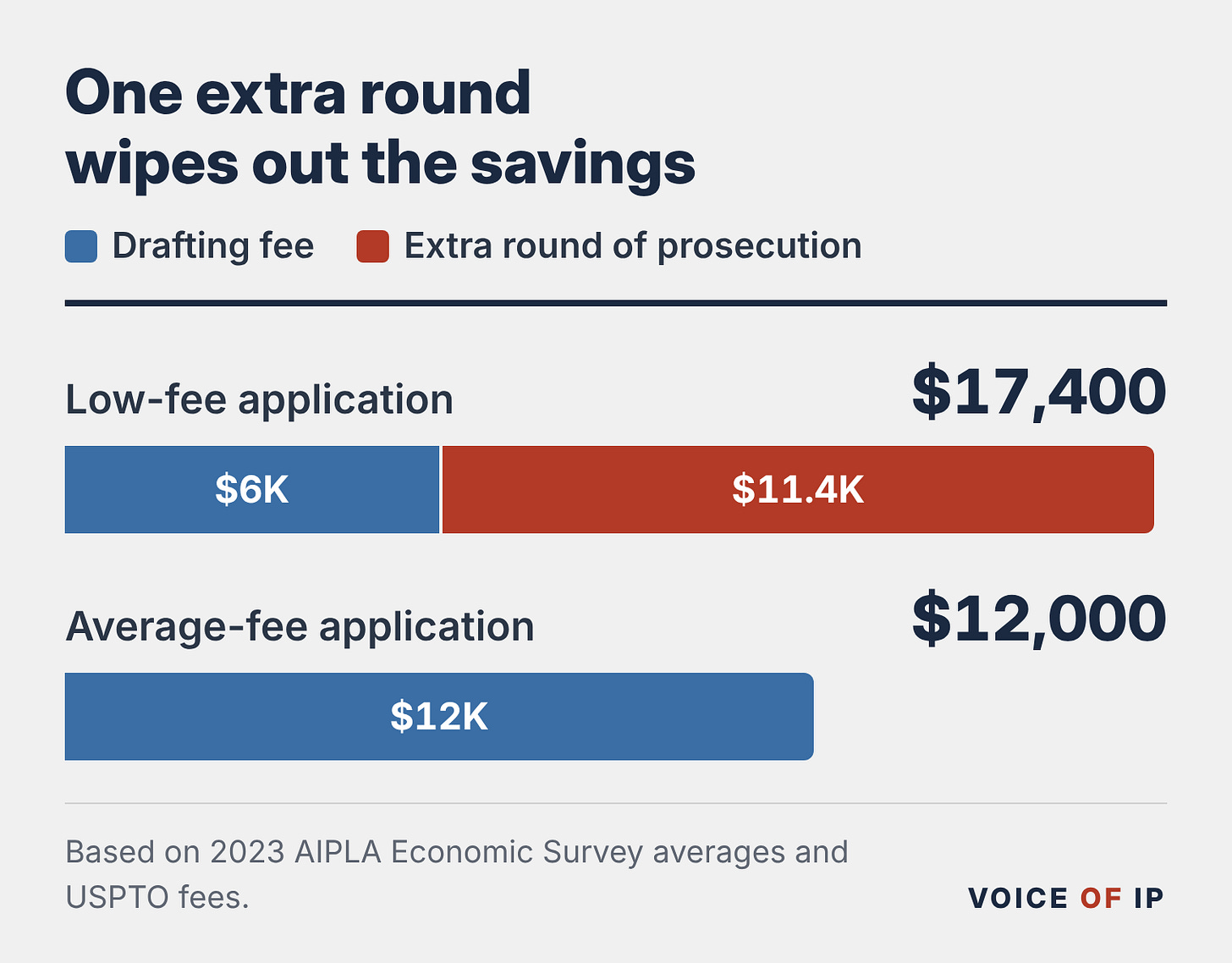
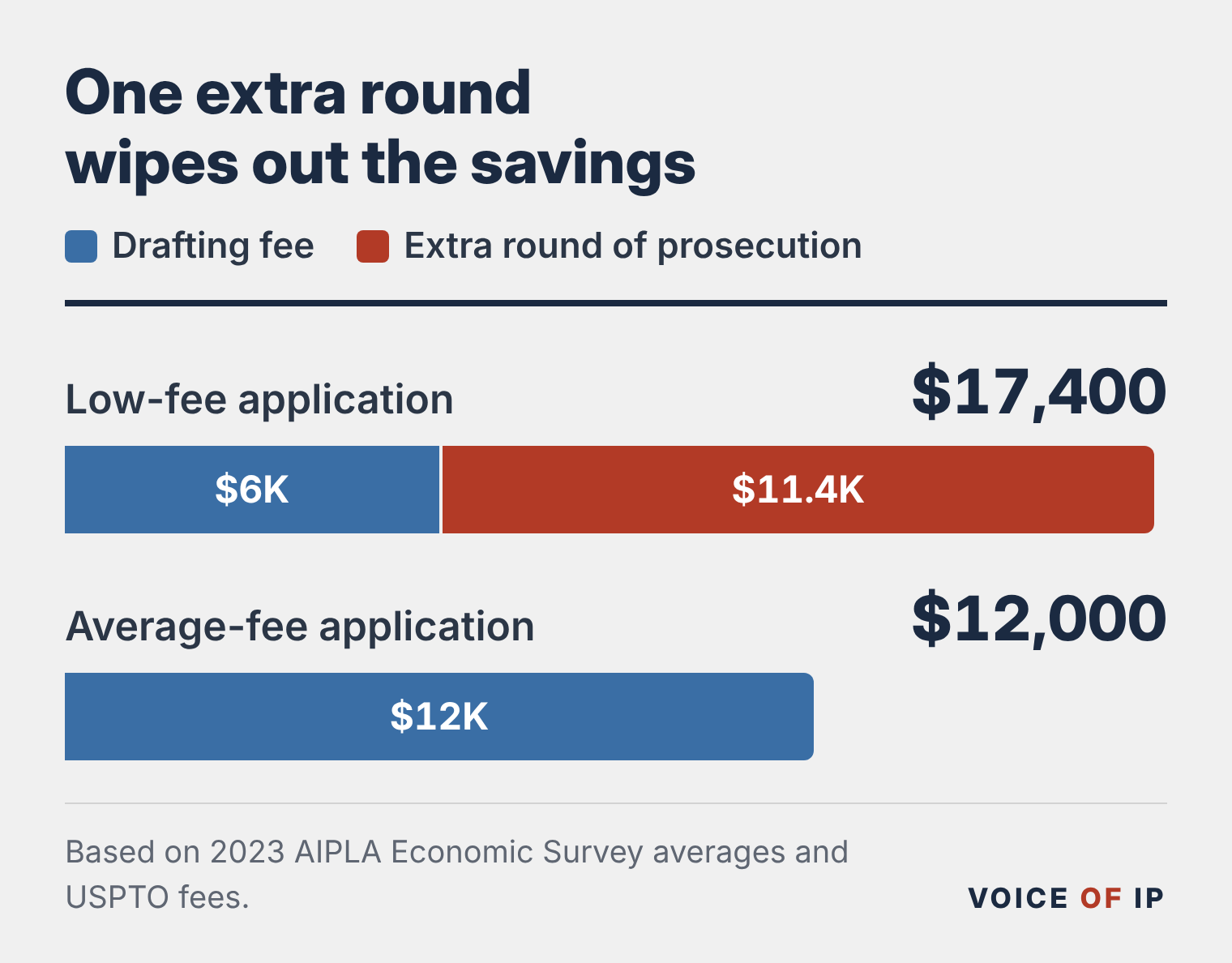
Extra round of prosecution costs more than potential savings: Even savings of 50% on a new application, about $6,000, are gone if the weaker application leads to just one extra round of prosecution. That round can easily run $11,000 or more: about $8,000 for two office action responses, about $1,200 for an examiner interview, and an RCE fee of $1,500 to $2,860.
Wasted application: When a low-fee application ends in abandonment or claims too narrow to matter, not filing at all would have been the better and cheaper option, saving the filing and prosecution costs, along with the inventors’ time.
Continuation hole: When a weak application finally gets allowed with narrow claims, companies often spend more on continuations just to get reasonable scope on the same embodiment.
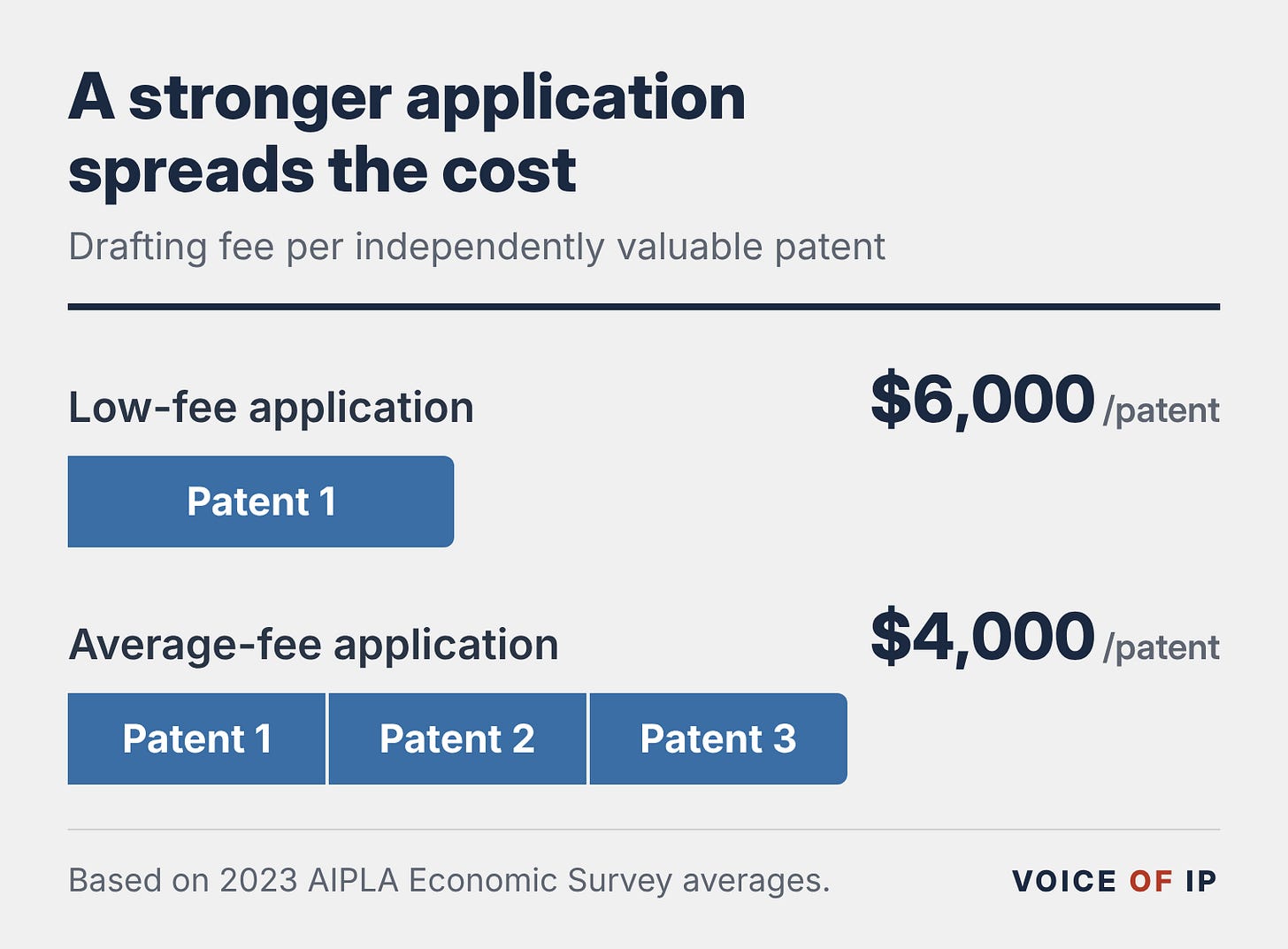
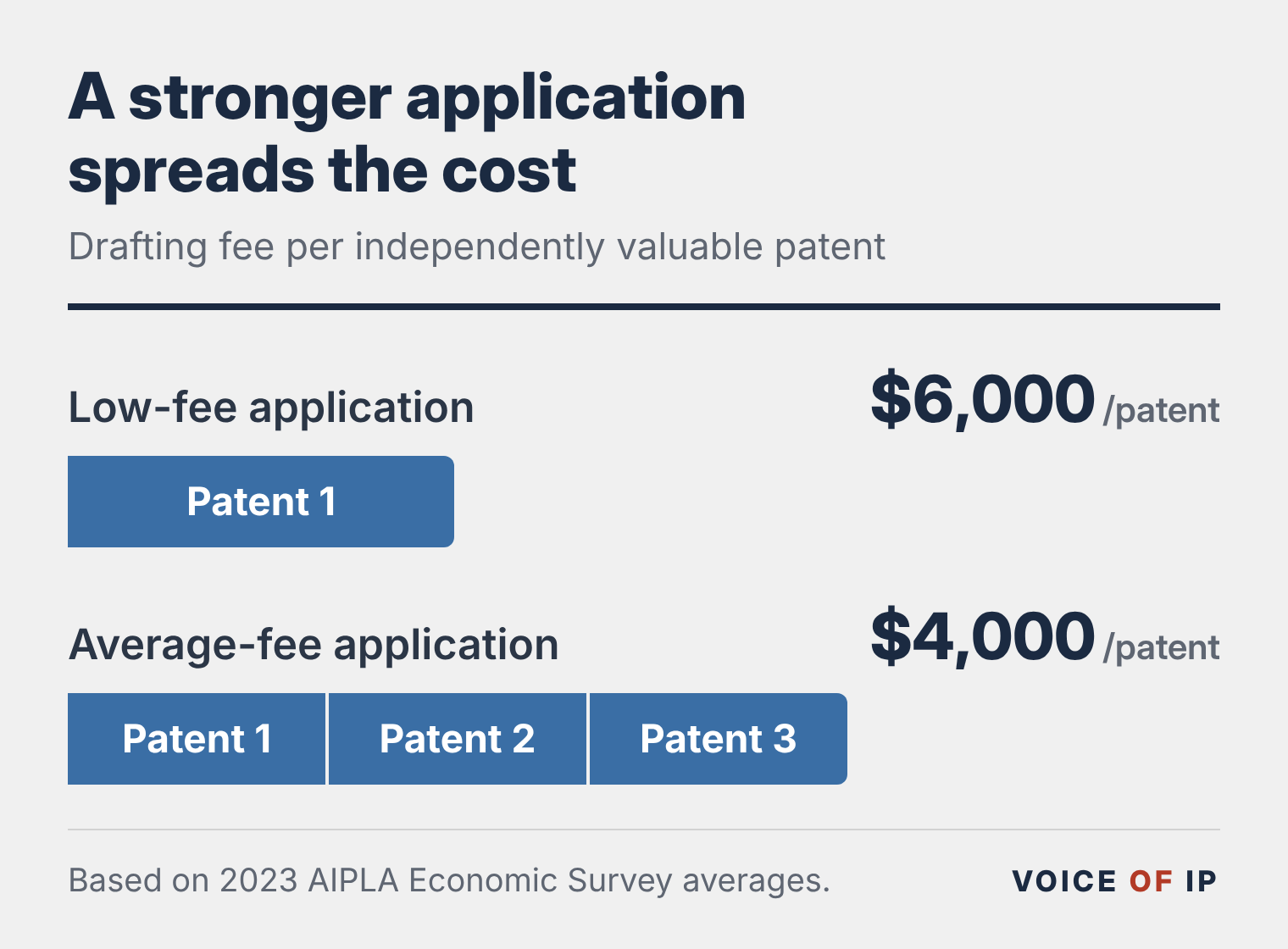
Narrow foundation: A low-fee application often focuses on a single, isolated embodiment covered by the original claims. A well-drafted application can support several independently valuable patents, and spread across them, the drafting fee looks very different.
Cutting patent drafting budgets isn’t new
I started practicing around the time of the Great Recession, when a lot of companies needed to cut their patent budgets. Many did it the simplest way: they cut the biggest fee on the fee schedule, the one for preparing and filing applications, sometimes more than once. Then they asked their firms whether they could live with the new number, and a lot of firms said yes. Even at the time, an article on patenting on a tight corporate budget warned that companies that pressed their counsel to work for less “are now discovering that this approach has resulted in lower quality work.”
There was no push to use AI for patent work yet, but there was always a new model that would change everything: fixed fees that dropped every year, reverse auctions, offshoring, moving prosecution in-house, low-cost translations of foreign filings, and, well before ChatGPT, software that promised to draft most of the application. Almost none of them lasted as envisioned. A major chipmaker’s reverse auction proved there’s always someone willing to do the work for less. Within a couple of years, it dropped the reverse auction approach because, its general counsel said, the quality “was lower than what we were willing to put up with.”
The simplest approach did last: some large filers kept getting firms, many of which depended on the work, to cut their drafting fees. Long before the AI boom, that pressure produced real efficiencies, including better use of technology. But even with them, the drafting budget often fell, and still falls, below what a well-drafted application requires.
Firms handle that differently. Some invest anyway, drafting for the client’s best long-term result rather than to the budget, usually where the attorneys managing the work own and care about the outcome. At firms where applications are routinely drafted by one attorney and prosecuted by another, the application stays in the box the client priced it in: no one attorney owns the result, and the promise is that whatever the budget, the firm will find a way.
AI patent drafting: the newest avenue
Used properly, AI patent drafting tools can make an application better and parts of the drafting process faster. The temptation is to believe that AI can now draft great applications at a fraction of the cost, and to set a fee that will likely only be met by filing whatever the AI produces, which makes the application much worse.
Anyone can run an invention disclosure form, possibly along with a recording of the inventor call, through a RAG system loaded with the client’s past applications and generate something that looks like a patent application. It might even lead to allowable claims.
The result may even look more substantial than a carefully drafted application: longer, with more detail. But much of that AI-filled detail can quietly mischaracterize what’s inventive and miss what’s actually important, in ways that are easy to overlook. That’s where the extra costs and the ceiling get set. A fee that effectively presumes the AI draft is nearly done risks locking those flaws in for good.
Corporate IP teams are taking very different approaches. Some are taking the time to understand where AI actually saves time, where it improves the final application, where it does neither, and why, even if that means spending more time and money per application for now. Others have already decided that their outside counsel can just do it in half the time with AI, and to some extent, their saying so makes it so.
Some legal service providers see that as an opportunity to pitch an AI-first vision: patent applications drafted with minimal attorney supervision, at a deep discount. Companies most open to that pitch may not care much about their patents to begin with, and some would rather patents mattered less across the board. For them, an application that merely looks right may be enough. Those that do rely on their patents should be clear about their own goals before following suit.
Where AI belongs in patent drafting
Avoiding AI isn’t the answer. There have always been bad patent applications, and bad patents. An AI-drafted application is likely to be better than a lot of what has been filed over the years. But that’s the wrong comparison. The real one is between a well-drafted application, using AI where it helps, and a mediocre one, which AI can now produce faster, cheaper, and better-looking.
At least, that’s how it looks today. AI keeps getting better at helping attorneys draft high-quality applications. (Disclosure: Junior, one of this season’s Clause 8 sponsors, builds that kind of tool.) The right fee may come down as those tools cut the time it takes to do the job well. But if history is any guide, the savings from low-fee applications haven’t always worked out quite as planned. AI can take over much of the writing. It doesn’t shorten the time an attorney spends understanding what inventors built and why it matters, or replace the judgment about what to claim and how to describe it. A blanket fee cut can squeeze out the work AI doesn’t do along with the work it does.
A bigger drafting budget doesn’t guarantee good outcomes, either. Paying more, with or without AI, doesn’t buy good work on its own. But focusing only on cutting the fee makes good work much harder to get.
Where to save on patents, if that’s the goal
The application drafting fee is the wrong place to start. The better measure is the total cost of getting a patent that actually provides the coverage the company needs, not the cost per application priced in its own box. By that measure, a cheap application that needs an extra round or a continuation isn’t cheap at all. Neither is one that never does what it was filed to do, whether it’s abandoned or allowed with claims no one would bother designing around.
Beyond that, there are real savings in being more selective about what to file and letting patents that no longer matter lapse instead of paying their maintenance fees.
Rather than paying less for weaker applications, companies can ask outside counsel to take some ownership of the results. Prosecution depends partly on where an application lands at the USPTO, but for high-volume filers, that luck evens out across a portfolio, and it’s a risk firms should be willing to share. One option: lower fees for any round of prosecution after the first.
The question now is whether AI is mainly used to justify cutting the cost of preparing and filing applications, or to improve the protection that comes out the other end. A better-looking application is only the beginning. It still has to hold up in prosecution and produce patents worth having.
The Reddit inventor at least knew which attorney he was getting. The AI-first pitch is that you no longer have to choose: still get the second attorney’s work at the first attorney’s price. Of all the places to give in to that temptation, the original application is the worst. Once it’s filed, you can’t go back and fix it.
Related: On last week’s Clause 8, I discussed this topic with Austin Walters, founder of IP Copilot (a Clause 8 sponsor), who thinks patents could drop from about $30,000 to $200. Listen here.
Eli Mazour is a patent attorney focused on standard-essential patent (SEP) strategy and on avoiding and overcoming §101 challenges for AI, software, and fintech patents. He also hosts Clause 8.