


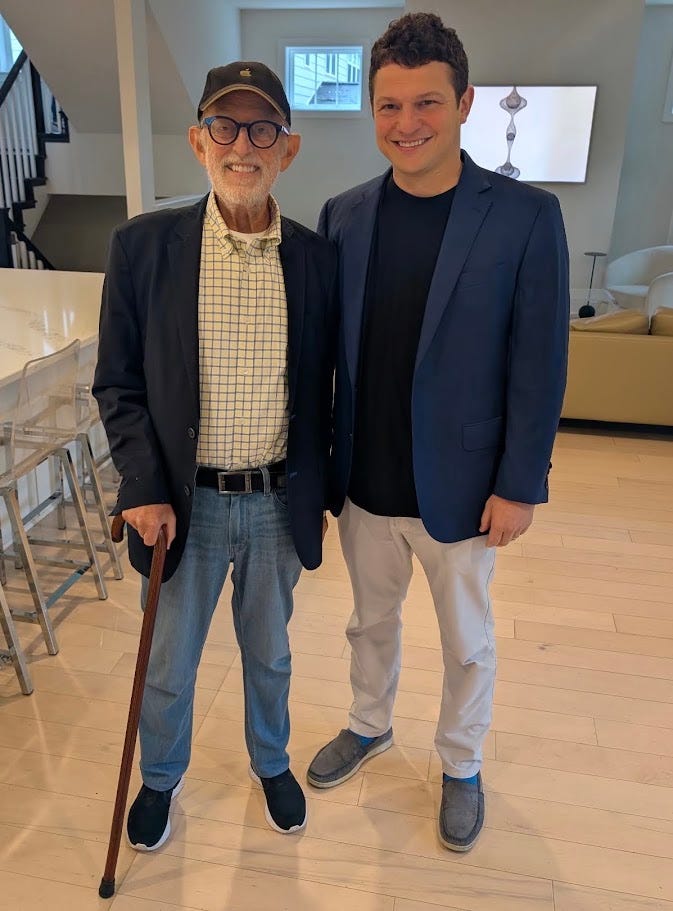
Perry Saidman was easily the most stylish guest on Clause 8. He arrived by Uber in a Burberry trench coat and an Apple baseball cap. Everyone asks about the cap, he told me, even people at Apple. He was clearly proud of it. Later, he mentioned that his firm still does “a substantial part of Apple’s work.” I didn’t know then that he would pass away less than a month later.
I first met Perry when I took his design law class at GW Law in my last semester. My mind was mostly elsewhere. But the class left me with a real appreciation for design patents as a valuable tool for clients to protect their products, and later their GUIs. For years afterward, whenever I faced a complicated design patent issue, my first instinct was to check whether Perry had written anything about it. He was the gold standard. When a court disagreed with him, I treated it as a temporary error that would eventually snap back to where Perry thought the law should be.
He also kept saying yes. When I was an editor for an issue of Landslide, I proposed that he co-author an article with my then-colleague Will Gvoth, and he agreed without hesitation. Years later, a friend starting his own firm got a request from a Bangladeshi firm to file a US design patent. As his questions became increasingly theoretical, I told him the only person who might have a credible answer was Perry. Perry had never met him but stuck with him until my friend was confident he was doing everything right.
After I started Clause 8, Perry went straight onto my list for the definitive episode on design patents. But we could never make the right day work for an in-person recording. At one point, health issues kept him from flying up from Florida. And I didn’t think a remote recording would do justice to the Godfather of Design Law. When I reached out for this new season, he immediately picked the earliest slot I offered: 9 AM on September 22 (“I’ll be more awake!”). That was the morning after Yom Kippur. The day before, I’d wondered whether booking four interviews right after the fast was the right choice. In hindsight, it was.
Clause 8 is brought to you by:
Junior AI - Your legal team’s documents, drafted in your team’s style.
IP Copilot - Discover, manage, and protect your IP.
The dining room turned Clause 8 studio
At the risk of ruining some of the mystery, the Clause 8 studio is on the second floor of my house. As my producer set up that morning, it crossed my mind that I hadn’t seen Perry in person in quite a few years, and maybe I should have mentioned the stairs.
He pulled up right before 9. He’d moved back full time to DC, where he was born and grew up, and made the trip on his own.
He stepped out with a cane, and I helped him from the car. When I told him we normally record upstairs, he was plain about it: no way. If he climbed those stairs, he’d have nothing left for the interview. Then he calmly made his way up my front steps.
Once we were inside, he told me, in the same matter-of-fact voice, that he had terminal cancer. I asked how the treatment was going. It wasn’t helping.
We moved everything down to the dining room, which happens to have black wallpaper covered in abstract line drawings of faces. As unplanned venues for interviewing the Godfather of Design Law go, it wasn’t a bad one.
He was quick, too. When one of my questions wandered, he looked at me and asked, “Could you restate the question, counsel?”
Late in the conversation, I asked whether he’d been artistic before design law. Not at all. “I was the kind who said, ‘Honey, go buy an armoire. I don’t care,’” he told me. Thirty years in the field changed that. Now, walking into a restaurant, “I either say ‘Wow!’ or ‘What were they thinking?’” He looked around the room, at the white piano and the white swivel chair he generously took for Herman Miller, and concluded somebody in the house had a good eye. “It’s either you or your wife.” My wife, I told him, but she occasionally listens to my input. “Good, good. Smart.”
After we wrapped, I showed him my wife’s office, which has pink wallpaper covered in leopards. He loved it. Then he noticed the printer cables on the floor and gave her idea after idea for hiding them. He couldn’t pass up a chance to make something look better.
I rarely ask guests for photos. I’m already conscious of taking up their time, and we’d run long. This time, for some reason, I asked. My wife took the picture below.
On the porch with Coke
Because we’d run over, Coke Morgan Stewart, my next guest, was already waiting outside. I introduced them and mentioned that Perry and I had discussed the USPTO’s 2026 design guidance on computer-generated interfaces during the recording. Coke dryly noted that it took only about six years to do it.
When I mentioned that Perry had started what became Sterne Kessler, Coke asked whether he knew Tracy Durkin, who now leads the firm’s Mechanical & Design Practice Group. “Pretty well,” Perry said. “I hired her.” Coke said Tracy, now back on the USPTO’s Patent Public Advisory Committee (PPAC) as vice chair, had provided helpful input on the guidance. “Plenty of opposition,” Perry said of it. “There are those who like designs and those who don’t.”
As he headed for his Uber, Coke said, “You’re an icon.”
Perry cocked his head to the side and opened his hands. “I tried.”
The Clause 8 conversation with Perry
Our conversation traces how Perry, in his words, had to “create the market, then sell the market” for design patents. It starts at a 1978 AIPLA dinner dance, where he sat with Joe Potenza of Banner Birch, a predecessor of today’s Banner Witcoff. Because the firm represented Nike, Potenza later sent him a running shoe inventor he couldn’t take on: the founder of Avia. After Avia introduced its first tennis shoes in 1985, LA Gear knocked it off within months but didn’t include the concave sole Avia’s utility patent covered. So Perry obtained two design patents for Avia, won on summary judgment in district court, and watched the Federal Circuit affirm. He started calling himself a design lawyer, a term nobody else was using, and the Washington Post profiled him in 1987 under the headline “Attorney Puts Foot Down About Sneaker Patents.” Before Avia, he said, design patents had a terrible reputation: “nobody won until I won.”
Perry also told the story of how he went from co-founding what became Sterne Kessler to striking out on his own with a firm dedicated entirely to design patents. In the late 1970s, Perry was of counsel at a small firm, out-earning the three partners, who wanted it the other way around. So he “remembered Rob Sterne,” whom he’d first met at a conference, where Rob was hustling in the best way. “I really liked Rob,” Perry said. “He was aggressive, he was young, he was bright-eyed and bushy-tailed.” In 1979, they founded Snider, Sterne & Saidman. Their first office was on K Street, directly above a topless bar, which Perry recalled made interviewing young recruits “very distracting.” After Snider left, Perry and Rob argued over whose name went first. Perry won: “Rob, you don’t know how to write a patent application. I do. And I have ten more years of experience. So it’s got to be Saidman.”
Perry was managing partner of Saidman, Sterne, Kessler & Goldstein when he left in 1990 to start Saidman DesignLaw Group, the first firm in the country dedicated to design patents. His old firm became Sterne, Kessler, Goldstein & Fox, now one of the largest IP firms in the country. When I asked why he left, I expected a grand vision about design law. His answer was simpler. Being a workaholic had already cost him one marriage, and he didn’t want that to happen again. The pitch to recruits was “your money or your life.”
Walking away from the top of the mountain didn’t faze him. As a kid, he ran a Kool-Aid stand, sold pot holders door to door with his sister, and worked as a Fuller Brush man, selling brushes out of a suitcase. “I am an independent cuss,” he said. “I hate to have bosses.”
He also spent a good part of our time on what he called the biggest issue facing the profession. In Egyptian Goddess, where he weighed in as amicus for Apple, the en banc Federal Circuit made “substantially the same in overall appearance” the sole infringement test and walked through decades of cases comparing designs “in light of the prior art.” Then, in one sentence with no precedent or explanation, it said courts could skip the prior art if two designs are “sufficiently distinct.” Perry called that “a gift to infringers.” In Range of Motion, Federal Circuit Chief Judge Kimberly Moore dissented on exactly that point. With Matthew Dowd and Robert Scheffel, Perry filed an amicus brief supporting rehearing en banc. It was denied, and he admitted the odds of the Supreme Court taking the case were close to zero. “But maybe we’ve planted seeds.”
At the end of our conversation, I asked Perry for any final thoughts. “This has been really fun,” he said. “More fun than I thought it would be.” Then he thought back to that dinner dance nearly 50 years earlier: “Hi, Joe, if he’s still practicing.”
In the episode
• Why he hired Donald Chisum as his expert in Avia, when nobody knew how to apply a subjective infringement test
• The LA Gear knockoff that made his “hard-fought” utility patent useless, and the two design patents that beat it
• His best deposition: LA Gear’s president picking up the Avia shoe and calling it his own
• How Apple v. Samsung did more for the design patent market than 22 years of his marketing (“corporate America woke the eff up”)
• Why the wrong design patents end up litigated, and how that hurts the whole system
• Claiming the “DNA” of a product in a design patent application, and why every added detail narrows the claim
• The “trick of the trade” of filing an appendix with lots of different embodiments, and why he’s still filing continuations for applications filed in 2001
• Why he’s fine with the “rubber stamp” critique of design examination and would go further, to a European-style registration system
• The “copy the iPhone” memo, and why the array and the colors on the home screen got Apple over the hump against Samsung
• On LKQ v. GM Global Technology Operations: “the Supreme Court loves to smack the Federal Circuit on the nose”
• Why replacement parts, like tractor teeth, are a real moneymaker, and design patents a great way to protect them
• His advice to lawyers to “specialize, specialize, specialize,” and why it came naturally to him to walk away from being king of the mountain
Watch the full conversation on YouTube (see above), or listen on your favorite podcast app.


