

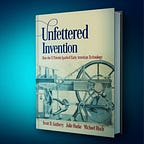

Earlier this year, Voice of IP published a list of 250 Patents That Built America. In this episode of Clause 8, returning guest Julie Burke, historian Scott Guthery, and Professor Michael Risch sit down with Eli Mazour to take that story back to the beginning with their new book, Unfettered Invention: How the X Patents Sparked Early American Technology.
The X-patents are the roughly 10,000 patents issued between 1790 and 1836. On December 15, 1836, a fire destroyed the Patent Office and nearly all its records. The patents that were later recovered got an “X” before their numbers to set them apart from the new series. Many were handwritten in cursive and had never been studied. On the episode, Guthery explains how he used AI and image processing to turn them into text. The authors also turned up roughly 500 X-patents missing from the archival record, and Risch describes original certificates surfacing on eBay, at auction houses, and in historical-society basements.
Clause 8 is brought to you by:
IP Copilot - Discover, manage, and protect your IP.
Junior - Your legal team’s documents, drafted in your team’s style.
An Unrecognizable System
Applications weren’t examined for novelty. Claims weren’t required at first. The Patent Office didn’t publish patents, so to see earlier inventions you had to travel to the model room in Washington, DC, or hope the patent turned up in the Franklin Journal, a technical journal for mechanics that reprinted some of them. When the Federal Circuit adopted its short-lived machine-or-transformation test in Bilski, Risch went back and read the X-patents by hand. He found that 30 to 40% would have been invalidated, including methods for teaching cursive handwriting and the violin. That was under a test that looks relatively lax by today’s standards.
Sparking vs. Documenting
The book’s subtitle says these patents sparked early American technology. Mazour presses the authors on that. When he published his list of 250 patents, some readers argued that patents don’t tell the story of innovation; they just document what was happening anyway. Guthery points back to Risch’s finding: Bilski’s test would have wiped out a big share of what the X-patents record. His case is that the open system was the point. “We’re better off having lots of people coming up with lots of ideas and not giving out… gold stars and sending everybody else to the corner of the room.” Why would a farmer bother to patent a washing machine fix? Guthery’s best guess is prestige, a certificate to hang on the wall, a motive he says is alive and well today.
The Lesson from 1836
The patent backlog is as old as the patent office. Burke describes clerks writing patents in ink on vellum until just before the Civil War (Clara Barton copied them by hand in the 1850s), while the office issued patents on early typewriters it couldn’t use itself. Today, she notes, examiners vent on Reddit about IT systems that keep failing. Mazour finds that oddly reassuring: America turned out fine anyway.
When Burke was last on Clause 8, there was speculation that the USPTO might answer its backlog with lighter examination. The 1836 office went the other way. It adopted examination, and “within six months the entire prior art collection burned to the ground.” Congress then had to pay to restore what it could. Today’s debate is whether the USPTO can keep the fees it collects. Burke wants more than that: outside funding, so the office can “get ahead of it upstream this time around.”
In this episode
How AI helped transcribe thousands of handwritten X-patents
What the X-patents are, and what the 1836 fire destroyed
Why early patents weren’t examined, and why two inventors could each get a patent for the same invention
How inventors found prior art without published patents
Why ordinary people filed patents, and why some were consumed by infringement
How early courts shaped novelty, utility, and patentable subject matter
Water wheels, bridges and Barnabas Langdon’s horse ferry
What 1836 suggests about funding today’s patent office
Where Risch thinks patent eligibility goes next, and what he thinks it will take for the Supreme Court to step in
🎧 Listen to the full episode above or on your favorite podcast app—and subscribe to the Clause 8 YouTube channel for bonus content.


